The history and origin of the protea
Explore the deep history of the protea — from ancient Greek mythology to South Africa's fynbos, and how it became a premium global florist flower.
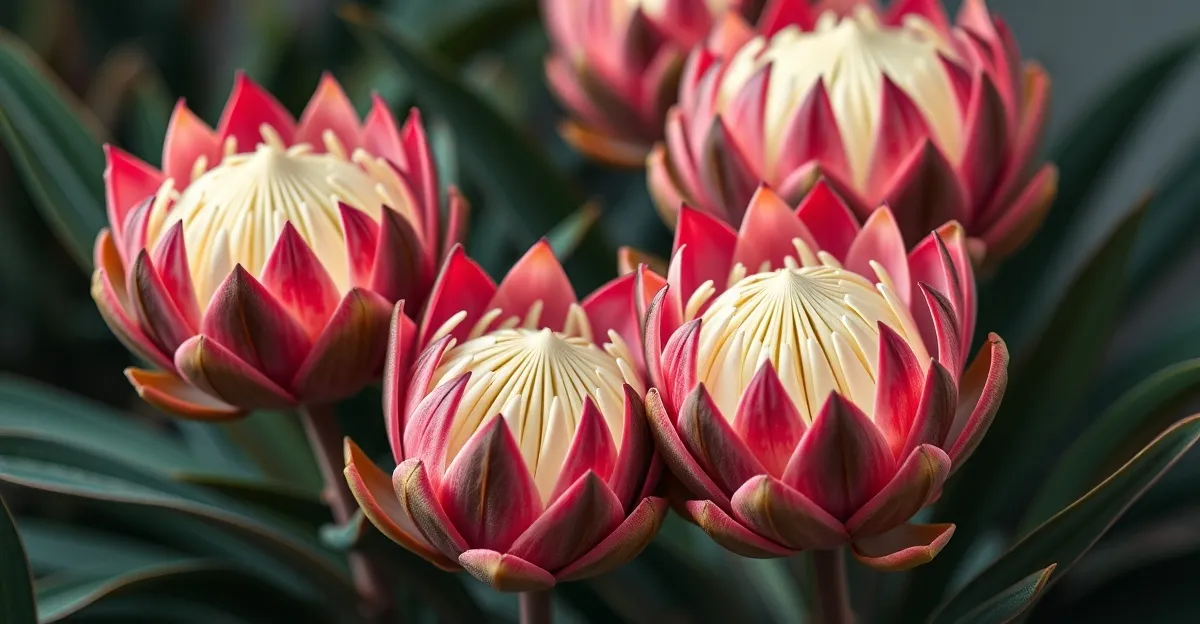
Protea is one of those flowers with a history deep enough to deserve genuine attention. It's not a flower someone developed in a hothouse over the last fifty years — it's an ancient genus, older than the continents as we now know them, with a lineage that stretches back to the last days of the supercontinent Gondwana. Understanding where protea comes from gives the flower an entirely different quality of meaning when you hold it.
The name and its origins in Greek mythology
The name "protea" comes from the Greek god Proteus — the shape-shifting old man of the sea in Greek mythology, who could change his form at will to avoid being captured. Carolus Linnaeus, the Swedish botanist who developed the modern system of botanical nomenclature, chose this name in 1735 to reflect the extraordinary diversity of the genus: its members range from ground-hugging shrubs to 10-metre trees, from tiny delicate blooms to the enormous flower heads of King Protea.
The genus name is a kind of acknowledgement that protea resists easy categorisation. Within the Proteaceae family, there are around 1,500 species spread across the Southern Hemisphere. The name suits the plant — endlessly various, hard to pin down.
Ancient origins: older than the continents
Proteaceae is among the oldest of all plant families. Fossil records show that plants in this family existed during the Cretaceous period — more than 90 million years ago — when the southern landmass of Gondwana was still largely intact. As Gondwana broke apart over millions of years into South America, Africa, Australia, India, and Antarctica, populations of Proteaceae were carried with each fragment.
This explains the extraordinary distribution of the family today: protea (Protea genus) is primarily found in South Africa; banksia is found in Australia; embothrium in South America; and grevillea across Australia and New Guinea. All belong to the same ancient family, separated by continental drift rather than by any recent dispersal.
King Protea (Protea cynaroides), the most well-known species and South Africa's national flower, is native specifically to the Cape Floristic Region — the fynbos biome that stretches along South Africa's southwestern coast. This small region is one of the world's six recognised plant kingdoms and has the highest density of plant species per square metre of anywhere on earth.
The fynbos: protea's home biome
To understand protea, you need to understand fynbos. This fire-adapted, nutrient-poor heathland is extraordinary — it supports over 9,000 plant species in an area smaller than Portugal, and protea is its defining genus. The word "fynbos" comes from the Dutch/Afrikaans for "fine bush" — a reference to the fine-leaved nature of many of the plants.
The fynbos has evolved with fire. Protea specifically requires periodic burning to release seeds and regenerate. Many protea species produce serotinous cones — seed cases that are sealed shut and only open in response to the heat of a fire. After a burn, protea resprouts from underground rootstocks or germinates from fire-released seeds, eventually dominating the recovering landscape.
This remarkable adaptation — thriving after destruction — is part of what has contributed to protea's cultural symbolism of resilience and transformation.
Colonial exploration and botanical documentation
European interest in the Cape's botanical diversity began with the Dutch East India Company (VOC) establishing a victualling station at what is now Cape Town in 1652. As VOC ships stopped regularly to resupply, Dutch and later European botanists and naturalists began documenting the extraordinary flora of the Cape.
Carl Peter Thunberg, a student of Linnaeus who visited the Cape in 1772–1774, was among the first to systematically document South African protea species. His work contributed significantly to early European knowledge of the genus. By the late 18th century, protea specimens were being grown in European botanical gardens, where their unusual forms attracted considerable scientific and aesthetic interest.
The first proteas to be commercially grown in Europe (primarily the Netherlands and the UK) appeared in the early 19th century, though the flowers remained botanical curiosities rather than commercial cut flowers for most of the 19th and early 20th centuries.
The rise of protea as a commercial cut flower
Protea's ascent in the global cut flower market accelerated significantly in the second half of the 20th century, driven by South African floricultural development and later by cultivation in Australia, New Zealand, Chile, and Israel.
South Africa began exporting protea commercially from the 1960s, with exports growing substantially through the 1970s and 1980s as Dutch flower auction infrastructure began handling South African product. By the 1990s, protea had become widely available through European florist markets.
The flower's entry into mainstream floristry in the 2010s — driven partly by social media aesthetics, the rise of the "wild garden" movement in floral design, and increasing global interest in unusual, structural flowers — transformed it from a specialty item to a widely desired centrepiece bloom.

The team
your florists
weekly subscription · Bali
We write about flowers because we love them. We deliver them because someone should — properly, weekly, across Bali.
— heyflowerPay once for 3, 6, or 12 months, no auto-renewal.
Protea's journey to Bali and Southeast Asia
In Bali and broader Southeast Asia, protea arrived through similar channels — initially through Dutch-influenced trade networks and later through air freight import chains from South Africa, Australia, and (increasingly) Thailand, which has developed highland protea cultivation in recent decades.
The flower resonates in Bali's design-conscious market — in the island's internationally minded villa scene, its boutique hotel culture, and its community of expat and local creatives who follow global floral trends. Protea's presence in Bali is a story about globalisation of taste as much as it is about botany.
FAQ: Protea history and origins
What is the oldest known fossil record of Proteaceae? Fossil pollen identified as Proteaceae has been found in deposits dating to approximately 90 million years ago, during the late Cretaceous period, confirming the family's extraordinary antiquity.
How many species of protea exist? The Protea genus contains around 115 species, while the broader Proteaceae family contains approximately 1,500 species across multiple genera including leucadendron, leucospermum, banksia, and grevillea.
Is protea endangered in the wild? Some protea species are threatened due to habitat loss — the fynbos is under pressure from urban expansion, agriculture, and invasive species in South Africa. However, King Protea (Protea cynaroides) itself is not currently endangered, and commercial cultivation is entirely separate from wild populations.
When did protea become South Africa's national flower? King Protea was declared South Africa's national flower in 1976. It appears on the South African coat of arms and is used extensively in national branding.
Is the Australian banksia related to protea? Yes — banksia is in the same family (Proteaceae) as protea. Both originated from Gondwana and share the family's characteristic complex flower heads, though they evolved separately after continental separation.
Ready to bring fresh flowers to your Bali home or event? Explore our weekly flower subscription and get handpicked blooms delivered to your door every week.
More on Protea