The History and Origin of the Bird of Paradise
Explore the fascinating history of the bird of paradise flower — from its South African origins and 18th-century European discovery to its place in Bali today.
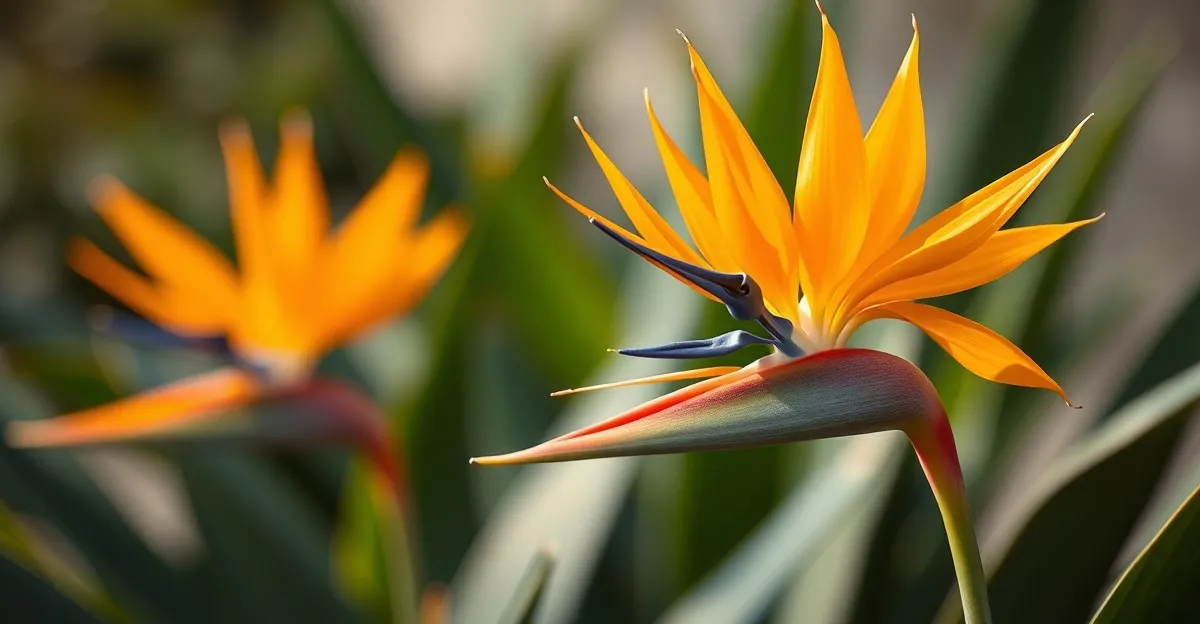
A flower named after a bird, shaped like a bird, and originally from a country that has no birds of paradise at all — the story of Strelitzia reginae is full of delightful contradictions. From its origins in the coastal forests of South Africa's Eastern Cape, through a royal naming that tied it to European botanical history, to its current status as one of the world's most recognisable tropical flowers, the bird of paradise has had a remarkable journey. Understanding where it came from deepens appreciation of what it means to receive or grow one today.
Origins in the Eastern Cape of South Africa
The bird of paradise is native to a relatively small geographic area: the subtropical coastal forests, river valleys, and rocky hillsides of South Africa's Eastern Cape province, roughly between the towns of Port Elizabeth (now Gqeberha) and East London. This region has a climate that could be described as Mediterranean-subtropical: warm, with defined seasons, moderate rainfall, and strong sun. The Strelitziaceae family, to which the bird of paradise belongs, evolved here in a landscape shaped by the Indian Ocean's moisture and the Drakensberg escarpment's rain shadow.
The Strelitziaceae Family
Strelitzia is one of four genera in the family Strelitziaceae. The other three are Phenakospermum (from South America), Ravenala (the Traveller's Tree of Madagascar), and Heliconia (the lobster-claw, widespread in tropical Americas and Asia-Pacific). The family's distribution across three separate continents tells the story of Gondwana — the ancient supercontinent that contained South America, Africa, and Madagascar before their gradual separation over millions of years.
The genus Strelitzia itself has five species, all native to southern Africa:
- Strelitzia reginae (the orange bird of paradise — the most widely known)
- Strelitzia nicolai (the giant white bird of paradise)
- Strelitzia alba (the white-flowered Cape bird of paradise)
- Strelitzia caudata (the mountain bird of paradise)
- Strelitzia juncea (the rush-leaved bird of paradise, with cylindrical rather than paddle-shaped leaves)
Each species adapted to slightly different conditions within southern Africa's diverse landscape, from coastal bush to high mountain valleys.
The Relationship with Sunbirds
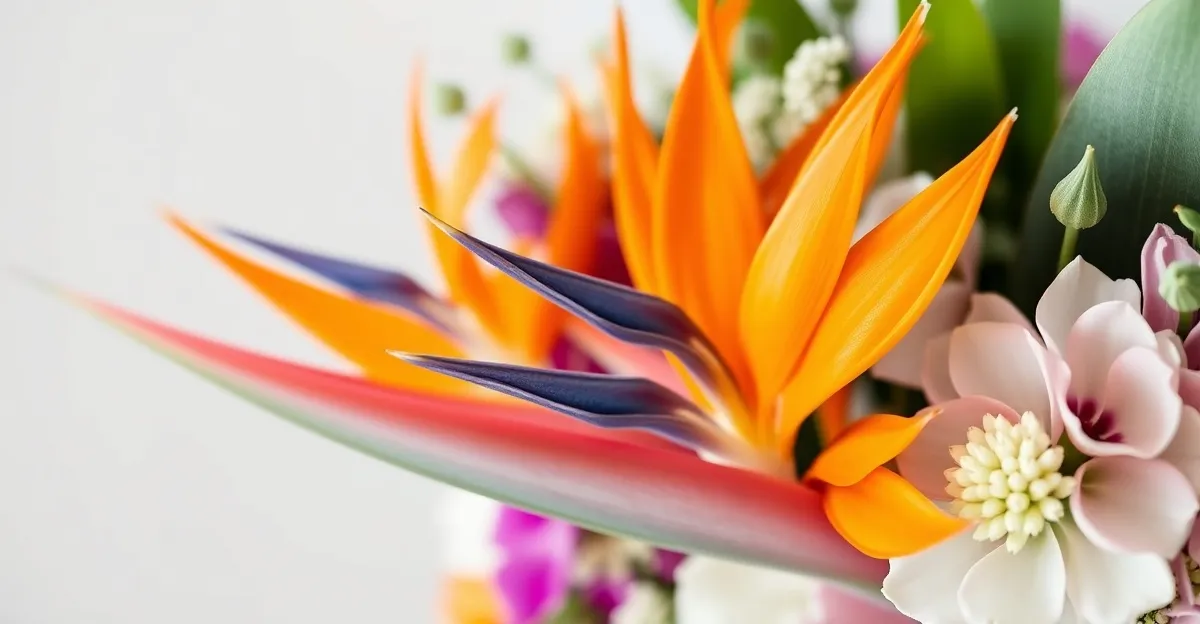
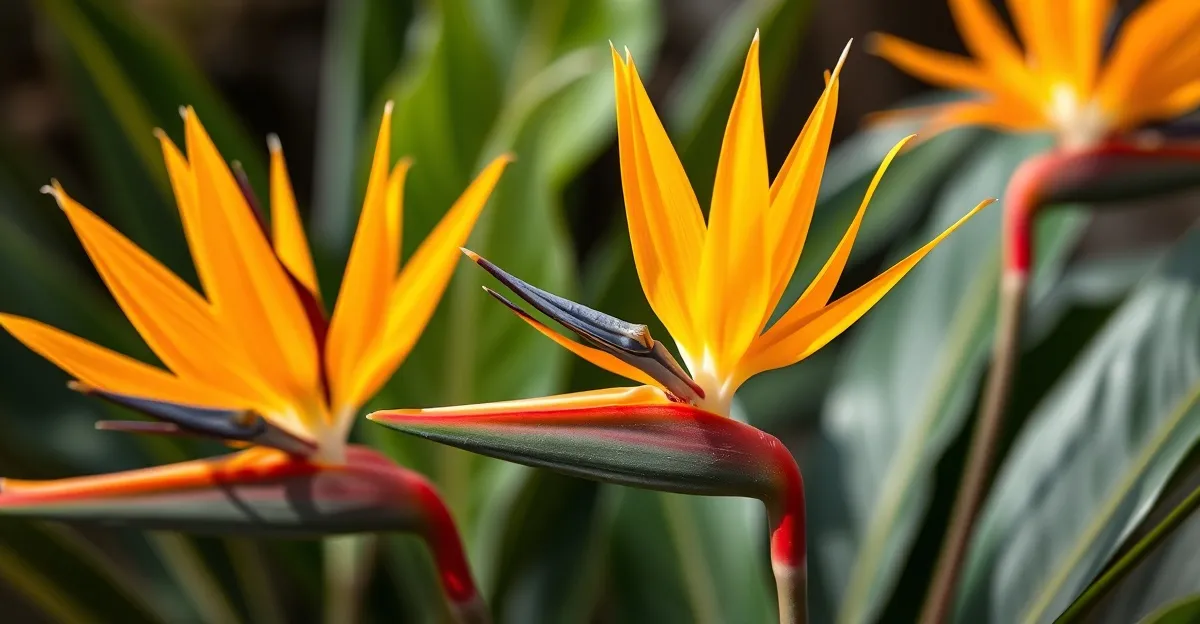
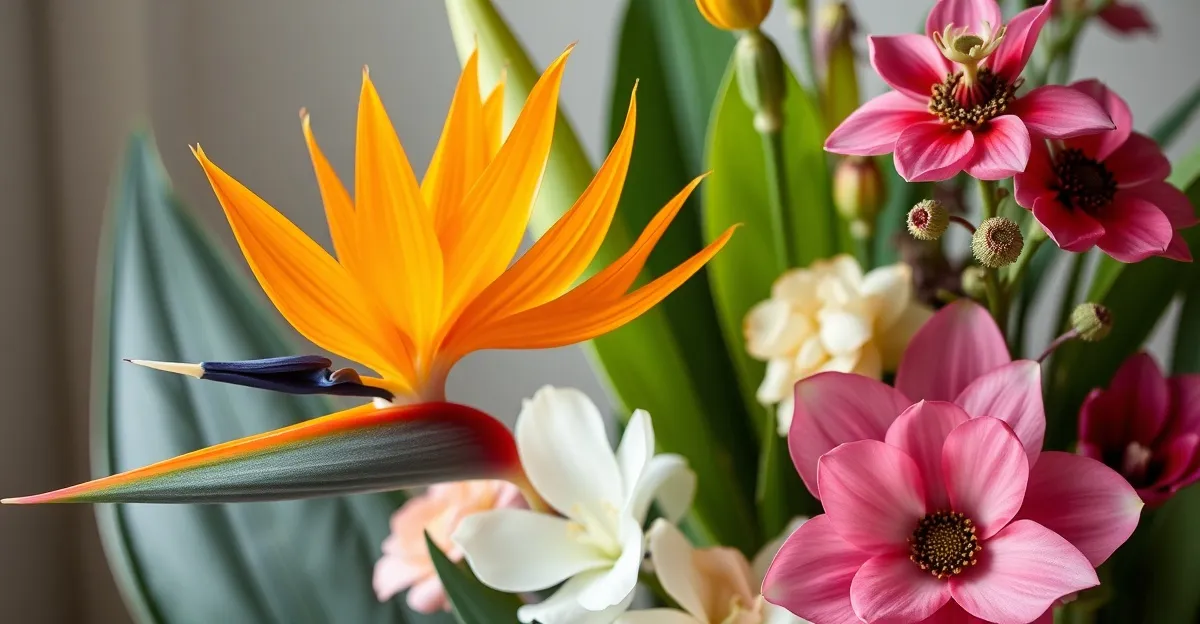
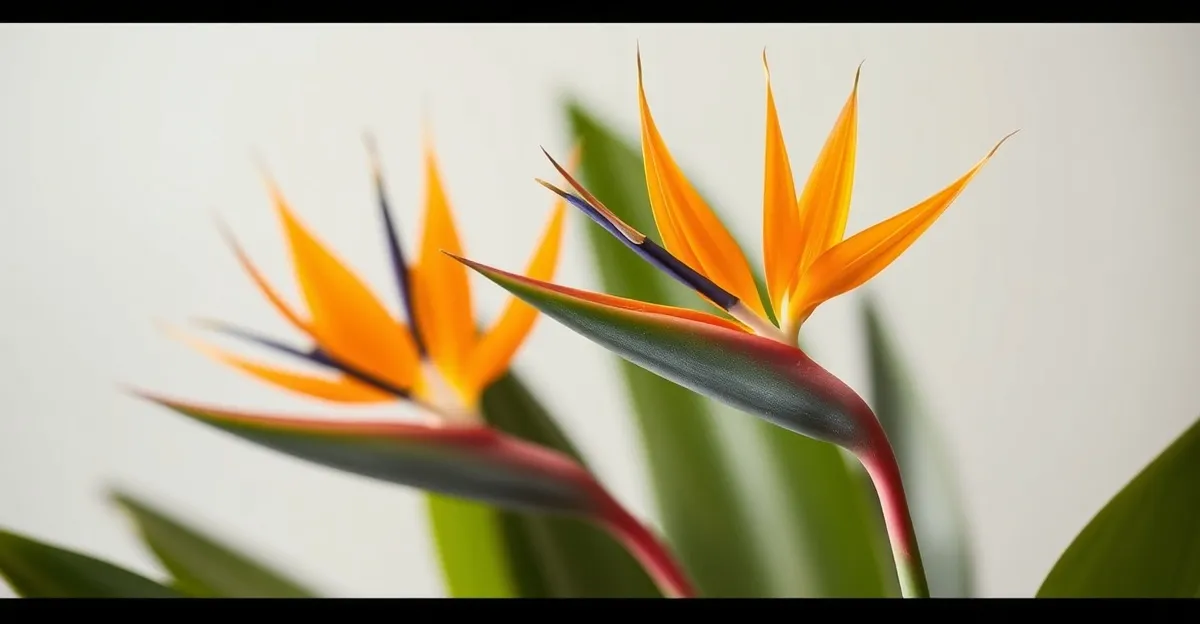
The bird of paradise evolved in an intimate ecological partnership with nectar-feeding sunbirds — specifically the Cape sugarbird (Promerops cafer) and related species. The flower's anatomy is designed for these birds: the deep blue spathe provides a landing perch for the bird while it feeds on nectar, and as the sunbird's feet press down on the spathe, it triggers the release of pollen that dusts the bird's feet and is carried to the next flower.
The bright orange petals serve as a visual beacon specifically calibrated to the colour perception of birds rather than bees. This is why bird of paradise orange is so pure and vivid — it was refined by evolution for maximum visibility against the green foliage of its native habitat to a bird's eyes.
The flower's common name derives not from this ecological relationship but from the visual resemblance of the bloom to the magnificent tropical birds of New Guinea (the actual birds of paradise, family Paradisaeidae). European naturalists who first saw the flower thought it resembled these birds' spectacular plumage.
European Discovery: The 18th Century
The bird of paradise entered European botanical knowledge during the period of intense natural history exploration that characterised the 18th century. European powers — Britain, the Netherlands, France — were sending naturalists on ships to document the flora and fauna of territories they were encountering for trade and colonisation. South Africa, as a key waystation on the sea route to India and Asia, was relatively well-documented early.
Francis Masson and Kew Gardens
The first recorded collection of bird of paradise by a European botanist is attributed to Francis Masson, a Scottish plant collector who worked for the Royal Botanic Gardens at Kew. Masson made several collecting expeditions to southern Africa between 1772 and 1775 as part of Captain Cook's second voyage. He collected specimens of the bird of paradise and sent them back to Kew, where they were cultivated and observed.
The first bird of paradise flowering recorded in Europe is documented at Kew Gardens in 1773. The event caused considerable excitement among botanists and aristocratic garden enthusiasts — tropical flowering plants were extraordinary novelties in 18th-century England, and the visual drama of the bird of paradise made it a sensation.
The Royal Naming
In 1788, the British naturalist Sir Joseph Banks formally described the species and named it Strelitzia reginae — "reginae" meaning "of the queen" in Latin. The Strelitzia genus name honoured Charlotte of Mecklenburg-Strelitz, the German-born queen consort of King George III of Great Britain. Charlotte was known for her strong interest in botany and natural history; she had been instrumental in expanding and developing the gardens at Kew.
The full name thus encodes a tribute to a queen known for botanical patronage — an appropriately regal name for a flower of such dramatic magnificence.
Colonial Distribution and 19th Century Spread
From Kew, the bird of paradise was distributed to botanical gardens across Europe and Britain's colonial network. Botanical gardens in Paris, Vienna, Amsterdam, and Madrid all received specimens. The plant's adaptability to Mediterranean and subtropical climates meant it established successfully in southern European gardens and in the colonies where those climates prevailed.
By the mid-19th century, bird of paradise was being cultivated in Mediterranean Europe, coastal California (where it was introduced by Spanish missionaries), South America, Australia, and increasingly across tropical Asia. In each new location it brought its South African heritage: robust, drought-tolerant once established, long-lived, and producing flowers with that unmistakable combination of vivid orange and deep blue.
Bird of Paradise Enters Commercial Floristry
The 20th century saw the bird of paradise move from botanical garden curiosity to commercial cut flower. California — particularly the San Fernando Valley and later the coastal areas around San Diego — became a major commercial production region, capitalising on a climate that closely matched the flower's native preferences.
By the 1960s and 1970s, bird of paradise cut flowers were appearing in florists' shops across the United States and Europe. Their extraordinary vase life — up to three weeks under good conditions — made them commercially attractive. Their visual drama made them popular with interior designers and event florists. The flower became particularly associated with California's aesthetic of casual luxury, and with Hawaii's tropical paradise identity.
Today, the bird of paradise is grown commercially on multiple continents: South Africa, the United States, Israel, Colombia, New Zealand, and across tropical Asia including Indonesia. It has become truly globalised, yet it carries its South African DNA in every bloom.

The team
your florists
weekly subscription · Bali
We write about flowers because we love them. We deliver them because someone should — properly, weekly, across Bali.
— heyflowerPay once for 3, 6, or 12 months, no auto-renewal.
Bird of Paradise in Bali Today
In Bali, the bird of paradise occupies a distinctive place in the local floral vocabulary. It is not indigenous to the island — Bali's own native tropical flora runs to heliconias, gingers, frangipanis, and orchids — but it has been cultivated here and arrived in Bali's commercial flower market as part of the island's integration into regional and global floral trade networks.
The flower's dramatic tropical presence makes it feel completely at home in Bali's aesthetic, even though it is formally a South African immigrant. It pairs naturally with the island's own flowers and foliage, and it resonates with Bali's own symbolic language of abundance, celebration, and the extraordinary.
For florists working in Bali, understanding the bird of paradise's history — its South African origins, its royal naming, its global journey — gives a richer context to every arrangement. It is a flower with a story as dramatic as its appearance. You can explore how it compares to other tropical flowers with deep historical roots in our piece on the history and origin of the lily, another flower whose journey from obscure local wildflower to global floristry staple has interesting parallels.
Frequently Asked Questions
Where does the bird of paradise flower originally come from?
The bird of paradise (Strelitzia reginae) is native to the Eastern Cape of South Africa, where it evolved in subtropical coastal forests and river valleys. It entered European botanical knowledge in the 18th century through plant collectors working for the Royal Botanic Gardens at Kew.
Who named the bird of paradise flower?
The species was formally named Strelitzia reginae by Sir Joseph Banks in 1788. The name honours Charlotte of Mecklenburg-Strelitz, queen consort of King George III, who was known for her patronage of botanical sciences and gardens.
Why is it called bird of paradise?
The flower is named for its visual resemblance to the spectacular tropical birds of paradise (family Paradisaeidae) of New Guinea. European naturalists thought the vivid orange and deep blue bloom, emerging from a dark spathe, resembled the plumage of these birds in flight.
How did bird of paradise spread from South Africa to the rest of the world?
Through 18th and 19th century botanical collection and distribution networks, particularly through Kew Gardens and the colonial botanical garden system. By the mid-19th century it had been introduced to California, South America, Australia, and across Mediterranean Europe. Commercial cut flower production developed in the 20th century.
Is bird of paradise the national flower of any country?
Yes. Bird of paradise (Strelitzia reginae) is the official flower of the City of Los Angeles, California, and is also associated strongly with South Africa's Eastern Cape region. It is not a national flower of South Africa — that distinction goes to the king protea (Protea cynaroides).
From the Eastern Cape to the markets of Canggu, the bird of paradise has had a long and magnificent journey. At heyflower.co, we bring it to your door freshly cut, beautifully arranged, and ready to transform your space. Explore our subscription options for regular tropical flower delivery across Bali.
More on Bird of paradise