Galungan and Kuningan: flowers in 10-day Balinese celebrations
Discover which flowers are used during Galungan and Kuningan, Bali's most important Hindu festivals, and what each bloom symbolises in the 10-day celebration.
Twice a year on the Balinese calendar — roughly every 210 days — the entire island transforms. Penjor poles arch over every road, the smell of incense hangs in the humid air, and every compound gate is dressed with fresh flowers. Galungan marks the victory of dharma over adharma, and for the ten days until Kuningan, Bali becomes more alive with colour and fragrance than at any other time.
If you live here or are lucky enough to visit during this period, understanding which flowers appear, why, and in what form gives you a completely different relationship with what you're seeing.
What Galungan and Kuningan actually celebrate
Galungan falls on Buda (Wednesday) Kliwon Dungulan — a specific intersection of the five-day and seven-day Balinese weeks. Kuningan follows exactly ten days later, on Saniscara (Saturday) Kliwon Kuningan. The mythology centres on the defeat of the demon king Mayadenawa by Indra, though at a deeper level the festival marks the periodic descent of ancestral spirits to visit their families and receive offerings.
During this period, Balinese Hindus believe their deified ancestors (pitara) return to earth. Families prepare elaborate offerings — and flowers are central to welcoming these spirits properly.
The penjor and its floral decoration
The most visible symbol of Galungan is the penjor: a tall bamboo pole, often five or six metres high, curved at the tip like a question mark and hung with decorations including coconut leaves, palm sugar fruits, woven ornaments, and fresh flowers.
The flowers on a penjor are not random. Yellow marigold (gumitir) is the most commonly used — its bright gold-orange catches the eye and is considered auspicious in Balinese Hindu practice. Marigold strings are woven through the bamboo framework, and in some villages you'll see them combined with white kenanga (ylang-ylang relative) or local frangipani (jepun).
Each family erects their own penjor at the gate of their compound, and in some neighbourhoods — especially along the main roads in Gianyar, Klungkung, and Ubud — the visual effect of hundreds of these poles bowing over the road is extraordinary.
Offerings and arrangements during the ten days
The banten or ceremonial offerings used throughout Galungan and Kuningan are some of the most elaborate in the Balinese calendar. Within these offerings, flowers are arranged according to direction and deity:
- White flowers (kenanga, white frangipani, white chrysanthemum) — associated with Iswara, the eastern direction
- Red flowers (red hibiscus, red anthurium, red carnation) — associated with Brahma, the south
- Yellow flowers (marigold, yellow frangipani) — associated with Mahadewa, the west
- Mixed/black — associated with Wisnu, north
For home shrines (pelinggih) in family compounds, these directions are observed carefully. The family's pemangku (priest) may specify the arrangement, particularly for the most sacred shrines like the padmasana.
The how to write a Galungan flower card message guide has more on adapting these traditions when sending flowers as gifts during the festival.
Bunga jepun (frangipani) during Galungan
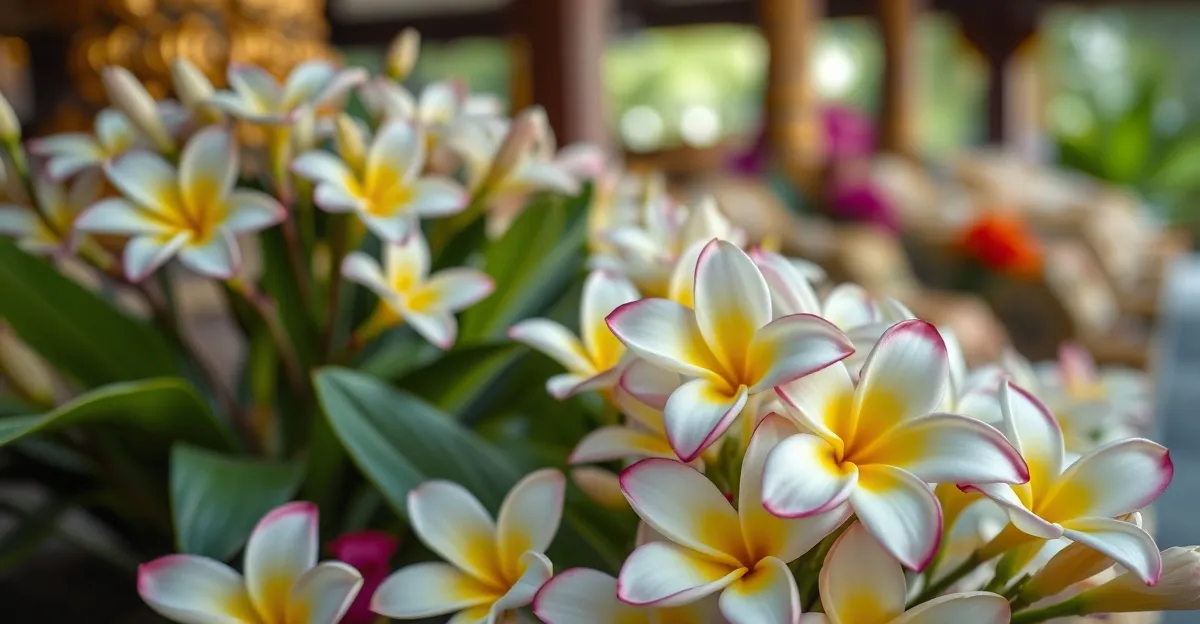
Frangipani is the backbone flower of all Balinese ceremony, and Galungan is no exception. During these ten days, demand for jepun spikes enormously. White frangipani with its yellow centre (Plumeria alba) is used in the most sacred offerings. Pink-tinged varieties appear in decorative garlands around shrines and gateways.
You'll see women on temple days carrying small bundles of frangipani tucked behind one ear — this is an everyday habit in Bali, but during Galungan almost every woman participating in temple activities follows this custom. The flowers are placed in the hair on the right side, meaning you're on your way to the temple; left side signals you've already attended.
The scale of frangipani use during Galungan means local trees simply can't supply demand. Flower markets in Badung (Pasar Badung is the largest), Gianyar, and Denpasar all see prices rise in the days before — typically by 30–50% for frangipani and marigold.
Kuningan day: the farewell flowers
Kuningan, the closing day, has its own distinct floral character. The name comes from "kuning" (yellow), and the dominant offerings on this day use yellow flowers — marigold, yellow frangipani, and sometimes imported yellow chrysanthemum.
Kuningan offerings are presented early in the morning before noon, because by midday it's believed the ancestral spirits have returned to the spirit world. The arrangements (particularly the nasi kuning, yellow rice offering) are accompanied by flowers in yellow, white, and gold tones.
Tambak offerings — conical towers of fruit, cakes, and flowers — reach their most elaborate form on Kuningan day. You'll see these carried on women's heads during processions, the fresh flowers balanced into the structure with remarkable skill.
Cherry blossom in Balinese ceremonies explores how imported blooms are sometimes incorporated alongside local flowers in more contemporary Galungan arrangements.

The team
your florists
weekly subscription · Bali
We write about flowers because we love them. We deliver them because someone should — properly, weekly, across Bali.
— heyflowerPay once for 3, 6, or 12 months, no auto-renewal.
Sourcing flowers during Galungan in Bali
If you're in Bali during this period and want to participate — either by decorating your home, preparing offerings, or sending flowers to Balinese friends — understanding the supply chain helps.
Markets open earlier during Galungan week. Pasar Badung in Denpasar starts filling with flower vendors by 3am in the days before the festival. For those in Seminyak, Kerobokan, or Canggu, neighbourhood warung often stock small bundles of ceremonial flowers. In Ubud, the morning market near the main temple always has good flower selection.
For prepared arrangements rather than loose flowers, it's worth ordering a few days ahead. Florists who supply ceremony flowers are often fully booked in the week before Galungan — demand from families, hotels, and villas all converge at once.
FAQ
When does Galungan fall in 2026? Galungan follows the 210-day Balinese Pawukon calendar cycle. The dates rotate relative to the Gregorian calendar — check a current Balinese calendar (kalender Bali) for the exact date, as it changes each cycle.
Is it appropriate for non-Balinese people to use Galungan flowers? Decorating your home with marigold or frangipani in the Galungan spirit is generally welcomed. Participating in actual temple offerings (entering shrines and placing offerings) requires a sarong and sash, and guidance from a local host or pemangku.
Why are marigolds so dominant during Galungan? Marigold (gumitir) is considered auspicious and is associated with the sun in Balinese Hindu symbolism. Its strong scent also serves a practical role — masking the smell of incense ash and keeping insects away from food offerings.
Can I buy Galungan flower arrangements for my villa? Yes — many florists in Seminyak, Canggu, and Ubud offer Galungan-inspired arrangements using marigold, frangipani, and yellow chrysanthemum. These aren't ceremonial banten but make beautiful seasonal decorations.
What happens to the penjor after Kuningan? Penjor are typically removed after Kuningan day. The fresh flowers are composted or offered back to the earth. Some families keep dried penjor elements as a blessing, but the living floral components are returned to nature.
Ready to bring fresh flowers to your Bali home or event? Explore our weekly flower subscription and get handpicked blooms delivered to your door every week.



