Frangipani in Balinese temples: why it's everywhere
Frangipani appears in every Balinese temple, offering, and ceremony. Here's why this flower holds such deep spiritual and practical importance in Balinese Hindu culture.
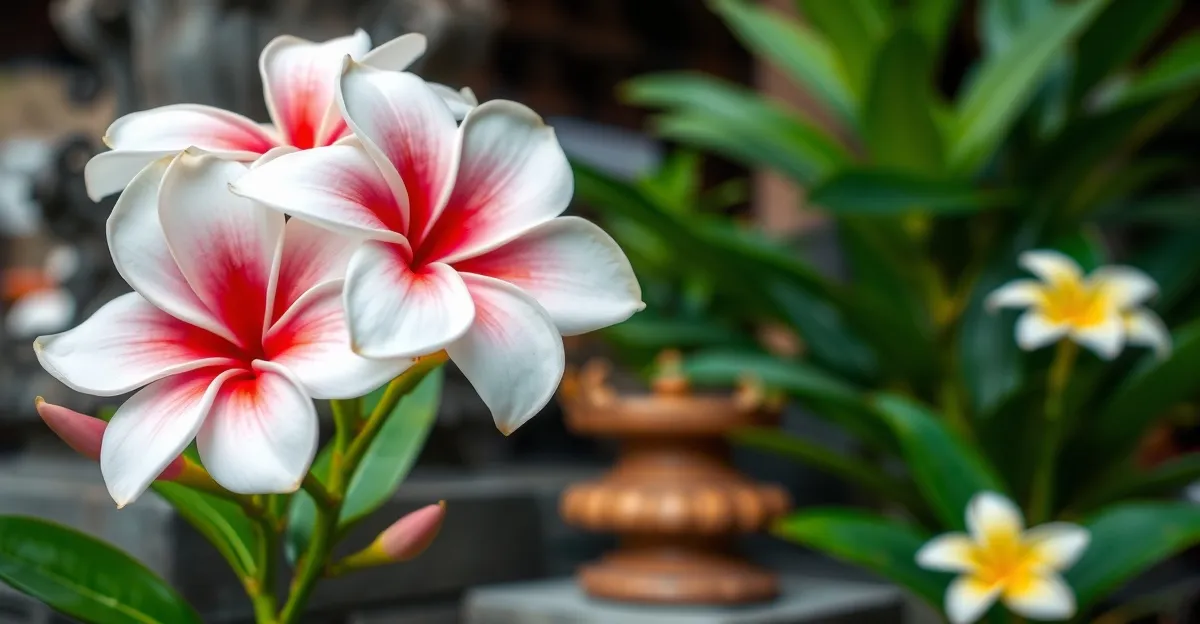
Walk into any temple in Bali — from the grand complex of Pura Besakih on the slopes of Gunung Agung to a small household shrine in a Kuta alley — and you'll find frangipani. Flowers on the offering trays. Petals floating in holy water. Trees planted at the entrance. Women with a single white bloom tucked behind one ear. Frangipani is so ubiquitous in Bali that visitors sometimes assume it's purely decorative — a design choice, a tourist aesthetic.
It's not. Frangipani's presence in Balinese temples is rooted in theology, practicality, and thousands of years of religious tradition.
The Balinese name and its meaning
In Bali, frangipani is called jepun. The most common variety — the white flower with a yellow centre — is jepun putih, and it's the one you'll see most in ceremony contexts. Pink frangipani (jepun bali) is also grown and used, as is the rarer red variety. The multi-petalled white species (Plumeria obtusa) is sometimes called jepun kampung.
The name jepun is specific to Bali. The plant is the same Plumeria genus known in the West as frangipani, in Indonesia generally as kamboja, and in other parts of Southeast Asia by various local names. In Java, kamboja carries funeral associations, which is why frangipani planted outside Bali can have different connotations. But in Bali, jepun is unambiguously sacred and joyful — a flower of the divine, not of death.
Why frangipani is spiritually significant in Balinese Hinduism
In Balinese Hindu cosmology, scent carries prayers toward the divine. Flowers are vehicles for spiritual intention, and fragrant flowers are more powerful vehicles. Frangipani has one of the most distinctive, penetrating floral scents in the tropical world — sweet, waxy, carrying far in warm air. When a priest fans burning incense over an offering that includes frangipani, the combined scent rises as prayer made tangible.
White frangipani specifically is associated with purity (suci), the divine, and the realm of the gods. In Balinese Hindu ritual, white corresponds to the east direction and to Iswara, one of the primary manifestations of the divine. Placing white frangipani in offerings or at shrines aligns the prayer with purity and divine presence.
There's also a practical theology at work. Frangipani flowers fall naturally from the tree — the tree sheds them continuously. This means that gathering frangipani doesn't require cutting or harming the plant. In a religious system where offerings are made multiple times daily, having a flower that can be gathered from the ground without violence to the plant is genuinely practical.
Frangipani trees as temple guardians
Many significant temples in Bali have ancient frangipani trees that are hundreds of years old. These trees are considered spiritually active — not just as decoration, but as presences. At Pura Kehen in Bangli, enormous frangipani trees grow within the temple courtyard, their roots wrapped around the stone terraces. At Pura Taman Saraswati in Ubud, the lotus pond and temple are framed by frangipani. At countless household temples across Bali, the jepun at the compound gate is the first spiritual marker of the sacred space.
When a new household compound is established, planting a frangipani tree is part of the founding process. When a temple is renovated or a new shrine built, frangipani is often planted alongside. The tree and the sacred space grow together.
Daily use in canang sari offerings
The most practical expression of frangipani's temple role is in canang sari — the small daily offering trays that Balinese women prepare and place throughout the day. Every canang sari contains a small flower arrangement by direction, and white frangipani is almost always part of it.
A Balinese household making two to three canang sari per day — for the house gate, the family shrine, the kitchen deity, and any other shrine — uses dozens of frangipani flowers weekly. Over a month, a single household goes through hundreds. This is why frangipani trees are planted at compound entrances: not for aesthetics, but so the family has daily access to ceremony flowers without having to go to the market.
The flowers are used fresh. They cannot be preserved or dried for this purpose — the living flower carries the intention. Which is why jepun (frangipani) in Balinese daily life is a story of constant, living abundance rather than stored supply.
Frangipani in temple ceremonies and festivals
During major ceremonies — Galungan, Kuningan, Pagerwesi, Saraswati, and any temple's odalan (anniversary) — frangipani appears in exponentially larger quantities. Large offering structures (penek, gebogan) are decorated with woven palm leaf work and fresh flowers, with frangipani at the crown of the arrangement. Temple entrances are draped with frangipani garlands. Processional costumes incorporate fresh frangipani woven into fabric headpieces.
At a full temple ceremony, hundreds of kilograms of frangipani flowers may be used across all the offerings, decorations, and personal adornment. The flower markets in Denpasar and Gianyar ship enormous quantities in the days before major ceremonies.

The team
your florists
weekly subscription · Bali
We write about flowers because we love them. We deliver them because someone should — properly, weekly, across Bali.
— heyflowerPay once for 3, 6, or 12 months, no auto-renewal.
Why frangipani falls continuously from the tree
One of frangipani's biological features is that it drops its flowers while they're still fresh. This isn't wilting — the flowers fall at peak bloom, often first thing in the morning. A well-established jepun tree can carpet the ground beneath it with perfect fresh flowers daily.
This is spiritually understood in Bali as the tree's natural generosity — it gives its flowers freely, without needing to be picked. Gathering them from the ground is an accepted and honoured way to collect ceremony flowers. It's part of why frangipani trees are so highly valued in household compounds.
For a closer look at the botanical reason behind this, why frangipani falls off the tree still fresh in Bali explains the science.
Frangipani and visitors
Visitors to Balinese temples are sometimes given a frangipani flower to hold or place as part of a prayer or blessing. Wearing a flower behind the ear is a common practice — it's not exclusive to Balinese people and is generally not considered cultural appropriation. However, context matters: wearing it to a ceremony you're attending as a respectful observer is appropriate; wearing it for a pool photo at a beach club and treating it as a prop is a different thing.
If you're visiting a temple, you'll often see frangipani available in small bundles at the entrance for purchase as an offering. Buying one and placing it on an offering tray, or simply holding it respectfully while inside the temple, is a way to participate genuinely rather than observe as a tourist.
FAQ
Why is frangipani planted at temple and compound entrances specifically? The tree marks the threshold between ordinary and sacred space. It provides daily ceremony flowers without needing to be cut, and its scent greets anyone entering the compound or temple.
Is it true that frangipani has funeral associations in other parts of Indonesia? Yes. In Java and some other parts of the archipelago, kamboja (frangipani) is associated with cemetery and funeral contexts. In Bali, this association doesn't apply — jepun is a temple and ceremony flower with positive, sacred meaning.
Can I plant a frangipani at my villa in Bali? Absolutely. Most Balinese families would consider it a natural and good thing to do. Frangipani grows easily in Bali's climate — it's drought-tolerant once established and loves the sun.
What colour frangipani is most commonly used in offerings? White (jepun putih) is the most common, associated with purity and the divine. Pink frangipani (jepun bali) is also used in offerings, particularly in some regions. Red or dark-coloured varieties are rarer.
Can frangipani be used in non-ceremony flower arrangements? Yes, and it's beautiful in home arrangements. The blooms last two to three days in a vase, and their scent fills a room. They're lovely floated in a bowl of water too.
Ready to bring fresh flowers to your Bali home or event? Explore our weekly flower subscription and get handpicked blooms delivered to your door every week.



