Jepun (frangipani) in Balinese daily life
Frangipani — jepun in Balinese — appears in every aspect of daily life on the island. From morning offerings to spa treatments to hair adornment, here's its full role.
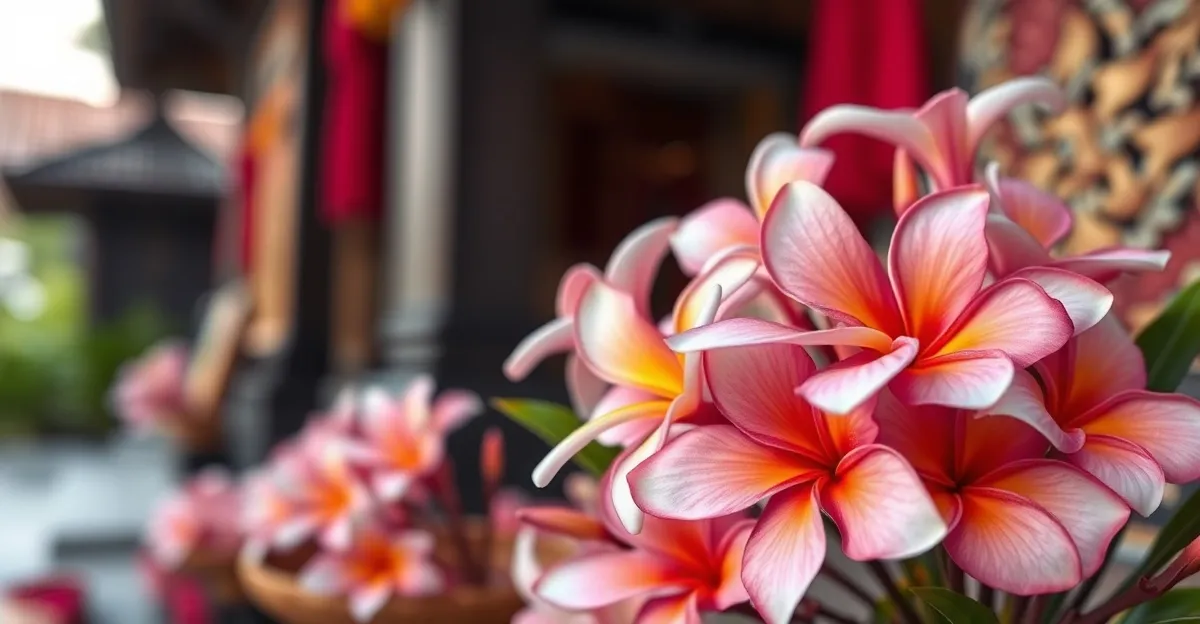
Ask any long-term resident of Bali what scent they associate most with the island, and the answer is almost always the same: frangipani. That sweet, waxy, carrying fragrance that lifts off the trees in the morning heat, fills temple courtyards, and drifts through villa gardens at dusk. It's not background ambience — it's the daily lived reality of a flower so central to Balinese life that its presence marks almost every transition from ordinary to sacred.
The Balinese name is jepun. To understand jepun is to understand something fundamental about how Balinese culture weaves the spiritual and the material into a continuous, daily fabric.
4am: the first morning offering
In a traditional Balinese household compound, the first act of the day — before coffee, before breakfast, often before full light — is making and placing offerings. The women of the household (though this is slowly changing in younger families) prepare canang sari: small palm leaf trays holding betel nut, lime, tobacco, and flowers arranged by cardinal direction. The flowers must be fresh.
Jepun is almost always among them. White frangipani in the east position, sometimes pink in another direction, combined with marigolds, champak, and whatever garden flowers the compound produces. The canang sari are placed at the gate, at household shrines, at the kitchen spirit shrine, and at any sacred stones or trees in the compound.
This daily practice means that a household in Bali may use 20–50 individual frangipani flowers per day across all its offerings. Across a year, that's thousands. The frangipani tree at the compound entrance isn't ornamental — it's a functional facility, as practical as a vegetable garden.
Morning markets and the flower trade
By 4am, the flower sections of Bali's major markets are already active. Pasar Kumbasari in Denpasar (which has dedicated flower stalls in the lower level) and the flower market adjacent to Pasar Ubud are among the most atmospheric early-morning market experiences on the island.
Sellers arrive with baskets of fresh-gathered jepun, bundles of marigolds still damp with highland dew, garlands of jasmine, champak blooms wrapped in moist palm leaf, and orchid stems from Bedugul. Women purchasing for daily ceremony use move through quickly, knowing exactly what they need. Restaurant and hotel staff buying for that day's decorations are there too.
Jepun prices at market are modest: a bundle of 20–30 white frangipani typically costs Rp 3,000–Rp 8,000 depending on season and quality. The flowers are gathered either from the ground under productive trees or carefully picked from branches on high-volume plantation trees in the highlands.
Jepun in the hair: an everyday aesthetic
One of the most recognisable images from Bali is the sight of women in kebaya (traditional blouse) with a white or pink frangipani tucked behind one ear. This practice — wearing jepun in the hair — is genuinely part of daily Balinese life, not a tourist-industry construction.
The placement has traditional meaning: behind the right ear indicates an unmarried woman; behind the left ear, married. In contemporary Bali, particularly among younger generations and in urban areas, this distinction is less strictly observed, and women (and some men) wear frangipani where they please.
Non-Balinese people wearing frangipani in their hair is not culturally inappropriate. It's a natural response to the beauty of the flower and its ubiquity. Many Balinese people find it charming when visitors wear it. Just be aware of the context: wearing jepun at a temple ceremony is different from wearing it as a poolside accessory.
Jepun in Balinese spa culture
The international popularity of the Bali spa experience — and the global spread of "Balinese massage" as a spa category — is inseparable from the scent of frangipani. Virtually every Balinese spa treatment involves frangipani in some form:
Flower bath: Floating frangipani petals in a warm bath, often alongside rose petals, marigolds, and tropical leaves. The milky latex from frangipani doesn't release significantly into the water, making it safe and pleasant for bathing.
Massage oils: Many Balinese massage oils use frangipani as a base fragrance, either from natural frangipani essential oil (which is actually quite rare and expensive) or from synthetic fragrance compounds that replicate the scent.
Room fragrance: Spas, villa reception areas, and hotel lobbies across Bali use fresh frangipani placed in bowls of water as natural room fragrance. A dozen fresh blooms floating in a flat stone bowl is both visually perfect and practically effective at scenting a space.
Welcome gestures: Many hotels and villas place a single fresh frangipani on the bed pillow as part of the room preparation — a practice that has spread globally but originates in Balinese hospitality traditions.
Jepun in ceremony: the full picture
Beyond daily offerings, jepun appears in every significant ceremony in the Balinese calendar:
Weddings: Jepun features in bridal headdresses (gelung agung), in the altar decorations, and in the banten (ceremony offering) structures. At traditional Balinese weddings, frangipani is as essential as the priest.
Ngaben (cremation ceremony): White jepun appears in offerings placed with the deceased, in the decorations of the bade (cremation tower), and in the ritual baths performed during preparation. For more on this, balinese hindu funeral flowers: protocol and meaning goes into detail.
Odalan (temple anniversary): On a temple's anniversary, which occurs every 210 days in the Balinese calendar, jepun is used extensively in the ceremony decorations and the offerings brought by worshippers.
Nyepi preparation: In the lead-up to Nyepi, purification ceremonies (Melasti) use white jepun abundantly. The flower's association with purity makes it particularly appropriate for a ritual that's explicitly about cleansing.
Rites of passage: From birth (nyambutin) through tooth-filing ceremonies (metatah) to marriage and death, every significant life transition in Balinese Hindu practice involves flowers, and jepun is almost always among them.

The team
your florists
weekly subscription · Bali
We write about flowers because we love them. We deliver them because someone should — properly, weekly, across Bali.
— heyflowerPay once for 3, 6, or 12 months, no auto-renewal.
Jepun in the garden: what to know
Frangipani trees are easy to grow in Bali's tropical climate. They're drought-tolerant once established, love direct sunlight, and prefer to be slightly dry rather than overwatered (root rot in continuously wet soil is the primary risk). They'll grow in almost any well-draining soil.
The trees can reach four to six metres over their lives, though they can be kept smaller with pruning. Some very old frangipani trees at significant temples in Bali are believed to be hundreds of years old — they slow down but don't stop.
Planting a frangipani at your villa, home, or business in Bali is always appropriate. It's a culturally resonant plant, practically useful for its flowers, and its presence marks a space as one that has taken root in Balinese soil.
The scent and why it's so recognisable
Frangipani fragrance is produced by terpenoid and benzenoid compounds that include geraniol, linalool, citronellol, and benzyl alcohol in various proportions depending on species. Different varieties have different scent profiles: some lean toward sweet and powdery; others toward spicy or citrusy notes. The classic Balinese jepun putih has a sweet, fresh, slightly citrus-edged fragrance that's distinctive from the heavier, more opulent fragrance of some hybrid varieties.
In the warm morning air of Bali — when temperatures are rising but haven't yet reached the full midday heat — the volatile compounds evaporate freely. This is why frangipani smells strongest in the morning and during warm evenings, and less intensely in air-conditioned spaces where temperature suppresses volatilisation.
FAQ
Is jepun the same thing as plumeria? Yes. Jepun is the Balinese name for Plumeria, the same genus known internationally as frangipani. Most Bali jepun are Plumeria rubra or Plumeria obtusa species.
Do all Balinese compounds have a frangipani tree? Not every compound, but it's strongly traditional. The tree at the entrance gate is so common that a compound without one is unusual. Some compounds have very old trees that have been there for multiple generations.
Is jepun used in Balinese cooking? Not traditionally in cuisine, no. Its sap is mildly toxic, and while the flowers are safe to handle, they're not eaten. However, some modern Balinese-inspired restaurants use the flower as an inedible garnish for its visual and aromatic impact.
What's the difference between jepun putih and jepun bali? Jepun putih (white frangipani, Plumeria obtusa) has a rounder petal and slightly different fragrance to jepun bali (Plumeria rubra in pink or darker tones). Both are used in ceremony; jepun putih is more common in offering contexts because white is the primary ceremony colour.
Can jepun be preserved or dried? Yes, though the fragrance diminishes with drying. Pressed frangipani flowers retain their shape and colour reasonably well and are used in some craft applications (resin ornaments, paper art). For ceremony use, only fresh flowers are appropriate.
Ready to bring fresh flowers to your Bali home or event? Explore our weekly flower subscription and get handpicked blooms delivered to your door every week.



