Canang sari: the daily Balinese flower offering explained
Learn what goes into a canang sari, the small daily flower offering made by Balinese Hindus, and why fresh flowers are essential to its meaning and preparation.
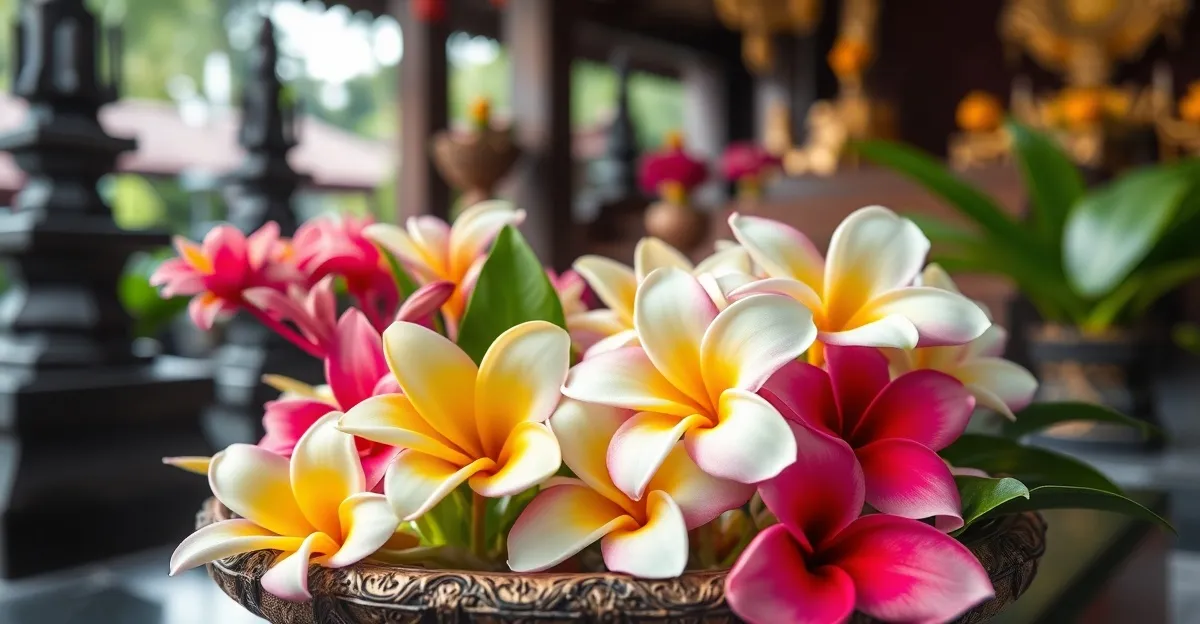
Walk through any street in Bali — Seminyak's lanes, the back roads of Ubud, the alleys of Denpasar's old quarter — and you'll step over small woven palm-leaf trays scattered with flower petals, a stick of incense burning beside them. These are canang sari, and if you understand what they are, Bali makes a different kind of sense.
Canang sari is the most fundamental unit of Balinese Hindu devotion. It is made and placed every single day by women throughout the island. The flowers in it are not decoration — they are the message.
What canang sari means
The name comes from Balinese: "canang" refers to the small palm-leaf tray (sokasi) woven from coconut palm, and "sari" means essence or core. Together, the term translates loosely as "essence of offering." The offering is placed to the divine, to local spirits (bhuta kala), and as a daily act of gratitude for life.
The philosophy behind it is called yadnya — sacred ritual as a form of devotion. By giving something that takes time, care, and cost to make, the giver acknowledges that life itself is a gift. There is no expectation of return; the offering is simply made.
This is why canang sari is genuinely non-negotiable for observant Balinese women. Missing a day is considered a spiritual oversight, not a trivial lapse.
The structure and its flower colours
A standard canang sari has a precise internal structure, and each flower colour occupies a specific cardinal direction:
- White flowers (east): associated with Iswara. White frangipani, white jasmine (melati), and white daisy are commonly used.
- Red flowers (south): associated with Brahma. Red hibiscus (pucuk) is traditional, though red carnations, red marigold, and red chrysanthemum are also used.
- Yellow flowers (west): associated with Mahadewa. Yellow frangipani, yellow marigold (gumitir), or yellow chrysanthemum.
- Blue or black flowers (north): associated with Wisnu. Blue hydrangea, purple flowers, or dark-coloured leaves like green pandanus can serve here when true blue flowers aren't available.
On top of this directional layer, additional elements are placed: sirih (betel leaf), gambir paste, betel nut, a small portion of rice, and sometimes a stick of incense. Frangipani petals are often scattered across the top regardless of colour.
How Balinese women make them each morning
The making of canang sari typically begins before dawn. A woman preparing offerings for her compound might make anywhere from ten to forty in a single morning, depending on the number of shrines, household spirits, and external placements required.
The palm leaf tray is folded fresh each time — dried or day-old trays are not considered appropriate. In practice this means that women either weave the trays themselves (a skill taught from childhood) or buy fresh pre-made sokasi from the market.
Flower sourcing follows a similar pattern: markets in Denpasar, Gianyar, Ubud, and Tabanan open before sunrise precisely to supply this demand. A typical bundle of mixed flower heads sufficient for one day's offerings might cost Rp 5,000–15,000 from a market vendor, depending on what's in season and which flowers are included.
For Balinese families who live closer to flower-growing areas — the cool highlands around Bedugul, the rural areas near Petang in Badung regency — growing their own flowers for daily offerings is common. Marigold, hibiscus, and frangipani trees are standard in compound gardens partly for this reason.
Where canang sari are placed
The placement locations in a Balinese compound tell you about the spiritual geography of the space:
- Padmasana (the highest shrine, facing Gunung Agung) — receives the most elaborate canang
- Sanggah/merajan (family temple) — each shrine or shrine tier receives its own canang
- Bale (pavilions and sleeping quarters) — placed at the entrance and near sleeping areas
- Dapur (kitchen) — at the hearth, for Brahma, deity of fire
- At the base of large trees within the compound
- At the compound gate
- On vehicles — canang are placed on car dashboards and motorcycle seats daily by many Balinese
Outside the compound, canang are placed at business entrances, on road corners, and at intersections — spots where spirits may gather or pass. The stepped-on canang you'll encounter on Bali's pavements are not a sign of carelessness; they've been placed on the ground intentionally, and their completion is what matters, not their pristine condition afterward.
The role of flower freshness
Freshness is not optional in canang sari. A wilted flower — something that would happen within hours in Bali's 30°C humidity — is considered inauspicious. This is why the offering cycle is daily: yesterday's flowers cannot serve today's purpose.
This has a direct practical effect on Bali's flower economy. Daily demand for small, fresh, affordable flower heads drives a significant portion of the island's cut-flower trade. Varieties that hold up well in the heat — marigold, chrysanthemum, heliconia — are valued not just for their colour but their durability in the hours between morning placement and heat wilting.
Can marigold grow in Bali? A florist's perspective explains more about why this flower has become so central to Balinese daily ritual supply.

The team
your florists
weekly subscription · Bali
We write about flowers because we love them. We deliver them because someone should — properly, weekly, across Bali.
— heyflowerPay once for 3, 6, or 12 months, no auto-renewal.
Canang sari and tourists
A common question from visitors: can non-Balinese people make or place canang sari? The short answer is that many Balinese people are genuinely touched when visitors engage respectfully with the practice — learning the colour directions, participating in a class, or simply acknowledging the offering rather than stepping over it.
What's not appropriate is treating canang as photo props, moving them from their placed positions, or entering a home shrine to interact with family offerings uninvited. Walking around rather than over them whenever possible is the minimum respectful gesture.
Several cultural centres in Ubud offer canang sari workshops — these are legitimate and often run by women who make offerings daily and want to share the knowledge.
Balinese temple flower etiquette for visitors covers the broader guidelines for respectful engagement with sacred flower practices in Bali.
FAQ
Is canang sari the same as banten? Not exactly. Banten is the broader term for all Balinese Hindu ritual offerings, which range from tiny daily offerings up to enormous ceremonial towers. Canang sari is one specific, small type of banten — the most common daily form.
What happens to canang sari after they're placed? Once an offering has been presented and the incense burned, it has fulfilled its purpose. Balinese believe the spiritual essence (sari) has been received; what remains is just the physical material. These are eventually swept up and composted.
Do men make canang sari? Traditionally this is women's work in Balinese culture, though it is the household's collective spiritual responsibility. Men participate in other aspects of ritual preparation, but the daily offerings are primarily a female domain.
How much does canang sari cost to make daily? A family compound might spend Rp 20,000–50,000 per day on flowers, betel components, and incense for daily offerings, depending on compound size and the number of shrines. This is considered a necessary household expense, similar to food.
Can I buy ready-made canang sari? Yes — pre-made canang are sold at markets throughout Bali, particularly near temples and in the early morning. However, many Balinese women prefer to make their own as part of the devotional act; the effort is considered part of the offering's value.
Ready to bring fresh flowers to your Bali home or event? Explore our weekly flower subscription and get handpicked blooms delivered to your door every week.



