Balinese temple flower etiquette for visitors
Visiting a temple in Bali means engaging with flowers and offerings. Here's what you should know about what to do, what not to touch, and how to participate respectfully.
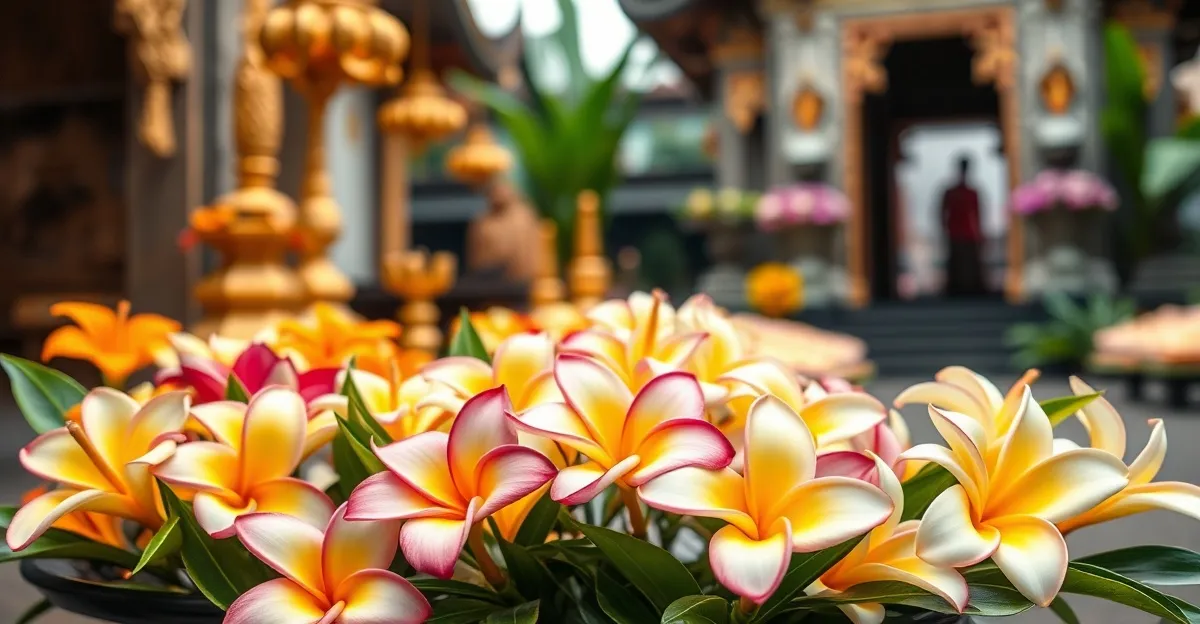
Bali has more than 20,000 temples — pura, merajan, and smaller shrines that dot every village, compound, rice field, and clifftop. If you spend more than a few days on the island, you'll walk past dozens and be invited into at least a few. Understanding how flowers function in these spaces — what to touch, what to leave alone, when it's appropriate to bring your own, and what the offerings mean — makes visiting more respectful and more meaningful.
Offerings are not decorations
The most important thing to understand before you enter a Balinese temple is that the flowers and offerings you see are not decorative objects. They're active spiritual communications — prayers expressed in physical form, placed by people with specific intentions. A canang sari (small palm leaf offering tray) placed at a temple gate with marigolds, frangipani, incense, and rice is someone's daily prayer. It's not there to be photographed close up, moved, or used as a backdrop prop.
This sounds serious, but it's not meant as a warning — it's simply orientation. Once you understand that every flower arrangement, offering basket, and petal scattering is a living ritual act, you automatically know how to behave around them: with the same respectful distance you'd give someone in the middle of prayer.
What flowers you'll see and where
At temple gates (candi bentar): You'll almost always see flowers placed at the base of stone gate pillars. Canang sari trays with marigolds, frangipani, and incense are refreshed daily. Frangipani petals often scatter across the ground from overhanging trees. Some gates have garlands of marigolds or cut flowers draped across the top on ceremony days.
At shrine bases (meru or padmasana): The multi-tiered tower shrines within temples have offerings placed at their bases — sometimes just canang sari, sometimes large elaborate banten structures with dozens of component offerings. These are off-limits to non-worshippers in terms of touch.
On offering tables: In the outer courtyard (jaba tengah), you'll sometimes see long tables set up with offerings being assembled before ceremony. Women often sit together making canang sari; the community activity is part of the ceremony culture.
In water features: Many temples have sacred springs or pools (petirtaan). Flower petals — frangipani, marigold, rose petals — are often floated in these. Pura Tirta Empul in Tampaksiring is one of the most famous, with spring-fed pools used for ritual purification bathing.
What you can do with flowers at temples
Bring your own offering: If you want to make a small offering as you enter a temple, this is generally welcomed. You can purchase a ready-made canang sari at markets near most major temples for Rp 5,000–Rp 15,000. Hold it in your right hand (or both hands), light the incense if there's a flame available, and place it at the base of a shrine after bowing your head briefly.
Receive a flower from a priest or temple attendant: At some temples, visitors are given a white frangipani or another flower to hold as part of entering the sacred space. Accept it with your right hand (or both hands). Hold it respectfully. Some priests will then guide you through a brief prayer gesture — hands together, flower raised to forehead. Follow their lead.
Wear a flower in your hair: This is culturally neutral in Bali — it's what Balinese women commonly do, and visitors doing it are not appropriating anything. A single white frangipani tucked behind the right ear (unmarried) or left ear (married) is traditional. Behind either ear as a visitor with no marital claim is fine.
Pick up fallen frangipani from the ground: Frangipani trees shed fresh flowers continuously. Fallen blooms are fair to gather. This is actually the traditional way of collecting ceremony flowers — the tree sheds them freely, so they don't need to be cut.
What not to do with flowers at temples
Don't touch offerings placed on shrines: Once an offering has been placed, it's complete. Moving it, repositioning it for a better photo, or picking flowers from a placed offering tray is disrespectful. Even if you see wilted flowers or older offerings, leave them — their physical decay is part of their natural return to the earth.
Don't use flower arrangements as photo backdrops in close proximity: Stepping over offerings, kneeling next to them for a social media photo, or positioning your face next to a placed offering for a shot is inappropriate. General wide shots of beautiful temple spaces — from a respectful distance — are different.
Don't remove flowers from shrines: This should be obvious, but to be explicit: flowers and offerings at shrines should not be collected as souvenirs or mementos.
Don't scatter flower petals without context: In some tourist experiences, visitors are given flower petals to scatter. This can be beautiful and appropriate in the right context. But randomly scattering petals around a temple because it looks pretty is different from participating in an intentional ceremony act.
Ceremony days and peak flower use
On temple anniversary days (odalan), major holy days (Galungan, Kuningan, Saraswati, Pagerwesi), and significant moon days (Purnama, Tilem), temples see their maximum flower use. Hundreds of elaborate offerings, massive banten structures, and fresh flower decorations transform already beautiful spaces into something extraordinary.
On these days, major temples may restrict or limit visitor access to preserve the ceremonial space. This is entirely appropriate. If you're told you cannot enter on a ceremony day, respect it graciously. The ceremony is not a performance for your viewing — it's the Balinese community doing their religious practice.
If you are welcomed in on a ceremony day, understand that you're a guest in someone else's spiritual life. Pagerwesi day and its floral significance in Bali gives good context for what one of these major ceremony days looks and feels like.

The team
your florists
weekly subscription · Bali
We write about flowers because we love them. We deliver them because someone should — properly, weekly, across Bali.
— heyflowerPay once for 3, 6, or 12 months, no auto-renewal.
Dress codes and the overall picture
Flower etiquette is part of the broader question of temple visitor conduct. The two go together:
- Sarong and sash: Required at virtually all Balinese temples. Many rent them at the gate for a small fee. Don't try to enter without one.
- Remove footwear: At some temples, shoes come off before the inner courtyard. Follow local cues.
- Menstruating women: At some significant temples, menstruating women are asked not to enter. This is a traditional purity (sebel) consideration and is communicated by signage at the entrance.
- No disrespectful positioning: Don't sit on shrines, lean on sacred stones, or place yourself higher than the offerings or priests.
Keeping these considerations in mind along with the flower guidance above means you can visit Balinese temples in a way that's genuinely respectful rather than just rule-following.
Bringing flowers as a gift to a Balinese friend with a ceremony
If you have Balinese friends who are hosting a ceremony and invite you to attend, bringing flowers is a warm gesture. Choose ceremony-appropriate colours: white, yellow, and mixed tropical are safe across any ceremony context. Including some marigolds or frangipani in your gift shows you understand what those flowers mean here. Last-minute Galungan flower ideas for Bali has specific ideas for one of the most common ceremony occasions.
FAQ
Do I need to buy an offering to enter a Balinese temple? Usually not — but it's a respectful gesture that will be genuinely appreciated. Ready-made canang sari are sold near most temples for a few thousand rupiah.
Is it disrespectful to photograph flowers at temples? Not inherently. Respectful photography from a distance is generally fine. Getting very close to placed offerings, touching them to reposition, or making offerings the focus of your photo without any spiritual context is less appropriate.
Can I take a frangipani flower that has fallen from a temple tree? Yes. Fallen frangipani is generally available to gather. In fact, this is how many Balinese families collect ceremony flowers — the tree sheds them and they are taken with gratitude.
What if I accidentally step on an offering? It happens, especially when there are many offerings placed at ground level. If you notice, step back carefully, bow your head briefly toward the offering, and continue. Don't make a scene of it, but acknowledge it.
What time of day is best to visit temples for a calm experience? Early morning, from 7am to 9am, before tour groups arrive. Many offerings are freshest and most beautifully placed in the morning after the day's first preparation. The light is also extraordinary.
Ready to bring fresh flowers to your Bali home or event? Explore our weekly flower subscription and get handpicked blooms delivered to your door every week.



