Balinese offering plates (banten) and flower rules
Understand the flower rules governing Balinese banten offerings — which blooms belong where, what colours mean, and why the placement of petals matters.
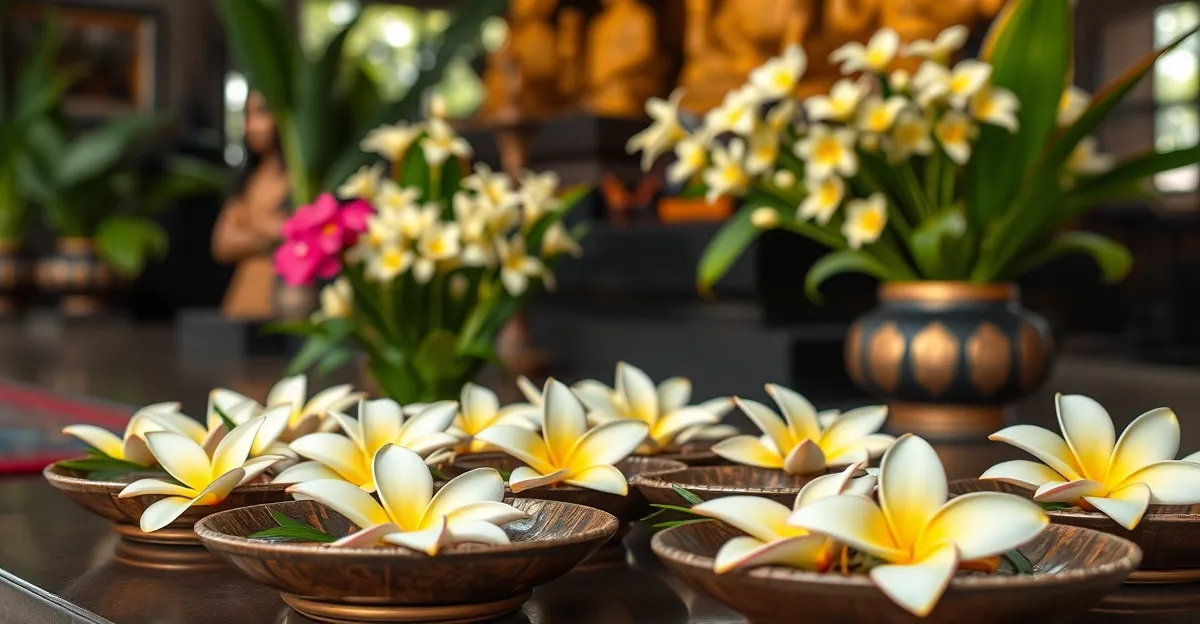
Every morning, millions of small square trays appear across Bali on doorsteps, shop counters, motorbike handlebars, temple steps, and road corners. These are canang sari, the most common form of banten — the Balinese term for offerings made to the divine. Each one is handmade, each one contains flowers arranged according to a specific logic, and each one is prepared fresh because yesterday's offering is already done its work. Understanding how the flowers in these offerings are chosen and placed gives you a much richer view of how Bali functions as a living ritual culture.
What is banten and how does it differ from canang?
Banten is the broad Balinese word for offerings — anything prepared and presented to the divine, from a simple daily tray to an elaborate structure carried on a woman's head at a major temple ceremony. Canang sari is the most common type: a small square base woven from young coconut leaf (ceper), filled with betel nut, flowers, and sometimes small food items, finished with a stick of incense.
The word sari means "essence" or "gift of the best" — the canang is not a transaction but an expression of gratitude and acknowledgment of the divine presence. The flowers in it are not merely decorative; they're chosen according to a system that encodes directional, elemental, and devotional meanings.
Larger categories of banten include sesajen (more elaborate offerings for specific ritual purposes), gebogan (towering fruit and flower structures for temple anniversaries), penjor offerings (fresh flowers woven onto the bamboo poles during Galungan), and banten tegteg (ritual offerings carried to temples for specific prayers). Each type has its own flower rules, which vary somewhat by region and family tradition but follow recognisable island-wide principles.
The four directions and their flowers
The core of the canang flower system is directional. The four sides of the square tray correspond to the four cardinal directions, and each direction is associated with a specific deity, colour, and ideally a specific flower type. The system, rooted in the Balinese Hindu cosmological framework of Panca Dewata (Five Deities of the Directions), works like this:
East (Iswara): White flowers. White plumeria (jepun putih) is traditional here, though white temple flowers of any kind are acceptable. East is associated with purity and clarity.
South (Brahma): Red flowers. Hibiscus is traditional, as are red roses, red cannas, or any strongly red bloom. South is associated with fire and creation.
West (Mahadeva): Yellow flowers. Yellow champaca (cempaka kuning) is ideal. Yellow marigold (tagetes) is widely used as a practical substitute. West is associated with water and sustaining life.
North (Wisnu): Blue or black flowers. This is the most challenging direction in practice, because truly blue flowers are rare in Bali's tropical flora. Blue or purple hydrangea, when available, works beautifully. Many offering makers use dark purple or near-black flowers, or substitute green in some family traditions.
In the centre, mixed flowers or fragrant flowers (often a mix of champaca, frangipani, and rose petals) are placed as an offering to Siwa, the fifth deity occupying the centre.
Which flowers are used and why
Beyond the directional rules, certain flowers carry reputational weight in the offering system that determines their frequency of use.
Frangipani (jepun): The most versatile offering flower. White and yellow varieties for east and west respectively, but frangipani in any colour is considered auspicious and appears throughout the offering. Its persistent fragrance is considered spiritually valuable — a flower that keeps offering its scent is a flower that keeps offering itself to the divine.
Champaca (cempaka): Particularly for west-direction yellow flowers, champaca is the most sacred choice. Its small, intensely fragrant blooms are available at every flower market.
Hibiscus (pucuk): Red hibiscus is the standard south-direction flower. It grows in most Balinese compounds, is harvested fresh each morning, and opens fully for the day's first offering.
Marigold (tegetes): Introduced from India with Hinduism's arrival, marigold is pragmatic gold. It's available year-round, inexpensive, long-lasting, and the colour is correct for western-direction placements.
Rose petals: Often used as scattered fill flowers or in the central pile, roses have become more common in offerings as their price has dropped with increased local cultivation. Red roses work for south placement; white for east.
Some flowers are traditionally excluded from offerings. Yellow and white jempiring (gardenia) has specific ceremonial associations that make it inappropriate for casual daily canang in some family traditions. Flowers that have dropped naturally from a plant (as opposed to being picked) carry connotations of death in some traditions and are not used.
Regional variations in flower rules
Bali is not uniform. Offering traditions vary significantly between villages, between the eight traditional regencies, and between priestly lineages. What's considered correct in Klungkung may differ from practice in Buleleng, and a high priest's compound in Ubud will follow different rules than an ordinary household in Kuta.
In North Bali (Buleleng), offering flower styles tend to be simpler and more practical. In the Pita Maha-influenced artistic heartland of Ubud and surrounding Gianyar, offering aesthetics are often more elaborate, with flowers chosen and arranged with particular attention. In the Majapahit-descent noble compounds of Klungkung and Karangasem, very specific flower varieties are required for certain offering types based on ancestral instruction preserved in family lontar manuscripts.
These variations are not errors or deviations — they're evidence of Bali's living relationship with its own ritual tradition, where local knowledge and family heritage shape practice as much as island-wide principles.
Flowers to avoid: what doesn't belong in banten
The topic of "wrong" flowers in offerings is sensitive and complex. Rather than absolute rules, there are strong tendencies informed by colour symbolism, fragrance associations, and traditional use.
Certain white flowers carry funerary associations and are used specifically in death ceremonies — see our discussion in why some Bali families avoid white flowers outside of funerals. Using these flowers in everyday offerings would mix ritual registers in a way that Balinese people find uncomfortable, though the specific flowers considered inappropriate vary by family and village.
Flowers that haven't been ritually prepared (disucikan) — meaning handled without the usual attention to cleanliness and spiritual state — are considered less effective rather than actively wrong. The preparation of the offering, including the selection and placement of flowers, is itself a meditative and devotional act. Flowers grabbed carelessly from a fading arrangement and thrown into a canang are technically correct but spiritually thin, as most Balinese offering makers would understand it.

The team
your florists
weekly subscription · Bali
We write about flowers because we love them. We deliver them because someone should — properly, weekly, across Bali.
— heyflowerPay once for 3, 6, or 12 months, no auto-renewal.
How banten connect to Bali's broader flower culture
The daily production of offerings is why Bali has such a developed flower market infrastructure. Pasar Badung in Denpasar operates from 3am specifically because offering makers need fresh flowers before dawn. The village-level pedagang bunga (flower sellers) who set up at compound gates or temple entrances serve the continuous ritual demand that never slackens.
This creates a symbiotic relationship between Bali's flower growers, market traders, and households. Understanding banten and its flower rules helps make sense of why certain flowers are grown in such enormous quantities — and why seasonal shortages of specific blooms (champaca during Galungan week, for example) create real challenges for families trying to maintain their daily offering practice. For more on how ceremony seasons affect flower availability, see the Bali ceremony days flower calendar.
Frequently asked questions
Can non-Balinese make canang sari? Yes, with respectful intention and proper learning. Many Balinese families are happy to teach guests and long-term residents the basics. The preparation itself is considered as valuable as the offering, so approaching it with genuine care is what matters most.
Where do I buy banten flowers in Bali? Pasar Badung in Denpasar is the main wholesale source. Village markets in most areas of Bali have daily flower stalls, typically busiest from 5am-8am. In tourist areas like Seminyak and Canggu, specialised toko bunga (flower shops) stock offering flowers alongside decorative varieties.
How many flowers are needed for one canang sari? A standard canang uses roughly 5-10 individual blooms or small clusters, plus petals scattered in the centre. One bundle of 100 frangipani flowers is sufficient for about 10-15 canang. Most households prepare between 3-10 canang daily depending on how many shrines they maintain.
Are offering flowers ever reused? No. Once offered, flowers are considered to have done their ritual work and are not reused for another offering. Old offerings are composted or placed respectfully at the base of trees. Some hotels sweep and dispose of offerings that have been on display, but traditional households leave them until they deteriorate naturally or are washed away by rain.
What flowers are required for major ceremonies like odalan? Odalan (temple anniversary) ceremonies require far more elaborate banten than daily canang. Specific flower towers (gebogan), floral garlands for shrines, and ceremonial offerings for specific deities all have their own requirements, typically managed by the temple's congregation with specialist offering makers.
Ready to bring fresh flowers to your Bali home or event? Explore our weekly flower subscription and get handpicked blooms delivered to your door every week.



