Tilem dark moon rituals and flower offerings
Understand the flower offerings used during Tilem, Bali's dark moon day, and why this quieter ceremony requires different blooms than the full moon Purnama.
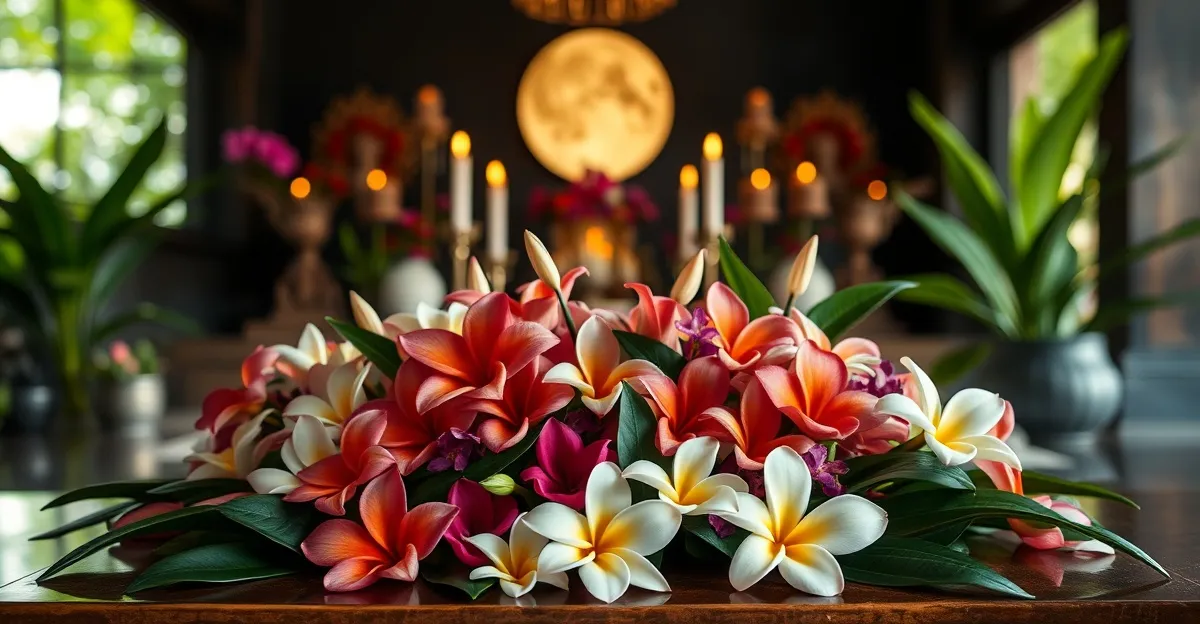
Where Purnama draws crowds to temple courtyards and calls for white flowers and bright-lit processions, Tilem — the dark moon — is a more inward affair. Every month, on the night when the moon disappears entirely from the Bali sky, Balinese Hindus observe rituals that are less about celebration and more about purification, release, and spiritual protection.
The flowers used at Tilem are not simply the inverse of Purnama's palette, but they do carry a distinct character. Understanding Tilem gives you a fuller picture of how Bali's lunar rhythm shapes its flower culture year-round.
Tilem in the Balinese ritual calendar
Tilem (sometimes spelled Tilem or Tilem) falls on the new moon — the last day of the Saka lunar month. It pairs with Purnama as the two lunar markers that bookend each month in the Balinese Hindu calendar. Together they are called Kajeng Kliwon — one of the most important recurring ceremony types, though Kajeng Kliwon actually falls every fifteen days on a different cycle.
During Tilem, the darkness of the moonless night is understood as a time when Bhuta Kala — lower spirits and disruptive energies — are more active. Rituals during Tilem therefore focus on ritual cleansing (melukat), propitiation of these lower forces, and strengthening spiritual protection for the household and community.
This is not a fearful event in Bali but a pragmatic one: you acknowledge the forces that exist, give them what they need to remain in balance, and maintain the harmony (tri hita karana) that underlies Balinese spiritual life.
The flower palette for Tilem offerings
The dark moon's offerings tend toward a different colour emphasis than Purnama's predominantly white palette:
Mixed dark and earthy tones: Unlike the elevated purity of white at full moon, Tilem offerings often incorporate more varied, darker flower combinations. Red and orange marigold feature heavily in Bhuta offerings, as do red hibiscus and dark-pink carnations.
Pandan and green plant material: Not flowers strictly, but woven pandan leaf is a significant component of the segehan offering — a ground-level offering specifically for Bhuta Kala. The fresh-cut smell of pandan is associated with neutralising negative energies in Balinese spiritual practice.
Yellow marigold (gumitir): Used broadly across almost all Balinese ceremonies, yellow marigold appears at Tilem in the directional offerings but also scattered freely in ground-level segehan placements.
White flowers retained at shrines: Even during Tilem, the higher shrines in a compound still receive the elevated offerings with white flowers — the distinction is between the elevated (divine, high) offerings and the lower (earthly, Bhuta) offerings, not a complete switch.
The segehan: offerings placed on the ground
The most characteristic offering at Tilem is the segehan, a simple banana-leaf tray placed directly on the ground or earth — at compound gateways, at road intersections, and at specific spots that are considered energetically sensitive.
A segehan contains rice (usually black rice, white rice, and yellow rice representing the three sacred colours), a small portion of food, and flower petals — most often marigold and hibiscus petals scattered across the surface. The offering is explicitly for the lower-plane spirits (Bhuta Kala), an acknowledgement of the forces that must be respected.
At Tilem, the number and placement of segehan increases compared to regular days. Areas that see heavy traffic — road junctions near Kuta, the market areas in Ubud, the beach temples along the Seminyak coast — all receive more elaborate placement.
Melukat: purification rituals at Tilem
Perhaps the most spiritually significant Tilem activity is melukat — sacred water purification. Several of Bali's holy springs and water temples are particularly active during the dark moon, drawing Balinese Hindus who seek to cleanse accumulated negative karma.
Flowers are integral to melukat. The offerings brought to a purification ceremony include a small banten (offering basket) with flowers following the directional colour system, plus additional fragrant flowers — particularly jasmine and frangipani — that are held in the hands during prayer and then offered to the water.
Pura Tirta Empul in Tampaksiring, Pura Beji in Sangsit (north Bali), and smaller spring temples throughout the island all see increased attendance at Tilem. The flower markets near these temples adjust accordingly.
Purnama full moon ceremonies: flowers used in Bali offers the complementary view of Bali's other monthly lunar ceremony, where the flower palette and mood contrast with Tilem's darker register.
Kajeng Kliwon: the intensified dark moon
Every 15 days, when Tilem coincides with Kajeng Kliwon — an auspicious (and demanding) day in the Balinese five-day and seven-day week system — the ceremonies intensify significantly. Kajeng Kliwon is one of the most powerful negative energy days in the Balinese calendar, and the propitiation offerings on this day are more elaborate and use more flowers.
Families that are normally less rigorous about their daily canang sari will typically prepare more careful offerings on Kajeng Kliwon. Flower use spikes noticeably in the markets on these days. When Tilem and Kajeng Kliwon coincide, the combination is called Tilem Kajeng Kliwon and is treated as a particularly significant purification day.

The team
your florists
weekly subscription · Bali
We write about flowers because we love them. We deliver them because someone should — properly, weekly, across Bali.
— heyflowerPay once for 3, 6, or 12 months, no auto-renewal.
How Tilem shapes Bali's monthly flower market
For flower vendors and florists in Bali, the Tilem-Purnama cycle is as reliable as the weekly market rhythm. Experienced vendors know to stock up on:
- Yellow and orange marigold for both Tilem and Purnama offerings
- White frangipani, larger quantities around Purnama
- Red hibiscus and mixed petals for Tilem segehan
For anyone running a subscription flower service in Bali, understanding the lunar cycle matters because it directly affects both supply (prices shift) and demand (what clients want changes with the ceremonial rhythm).
What happens on temple days for your subscription delivery has practical details on how ceremony days affect flower delivery schedules across the island.
FAQ
Is Tilem observed as strictly as Purnama? Generally, Tilem is observed with somewhat less public ceremony than Purnama — there are fewer large temple gatherings — but it's equally important in private household practice. Many devout Balinese consider Tilem more spiritually demanding precisely because its focus on purification and Bhuta propitiation requires care.
Why are ground-level offerings important at Tilem? The placement of offerings directly on the earth at Tilem signals that these are for the lower-plane forces (Bhuta Kala), not the elevated deities. In Balinese Hindu cosmology, height of placement corresponds to the spiritual level being addressed — sky/high for the divine, ground level for the earthly forces.
Can I attend a melukat ceremony as a non-Balinese person? Some melukat ceremonies at water temples are open to all visitors, and the experience is considered spiritually beneficial regardless of religious background. Bring appropriate flower offerings, dress respectfully in white, and ideally go with a Balinese guide or local contact.
Are the flowers for Tilem different colours than everyday canang sari? The directional colour system (white east, red south, yellow west, dark north) applies to both. What changes is the balance — Tilem emphasises more earthly and mixed-tone flowers for ground offerings, whereas the main shrine offerings maintain the standard palette.
How long does Tilem last? The dark moon day itself is one day in the Balinese Saka calendar, but the preceding afternoon and evening are also considered an active time for ritual preparation and early offerings. Most families complete their Tilem observances within a 24-hour window.
Ready to bring fresh flowers to your Bali home or event? Explore our weekly flower subscription and get handpicked blooms delivered to your door every week.



