Balinese Hindu funeral flowers: protocol and meaning
Balinese Hindu funerals (ngaben) have specific flower traditions rooted in the journey of the soul. Here's what flowers are used, what they mean, and how to show respect.
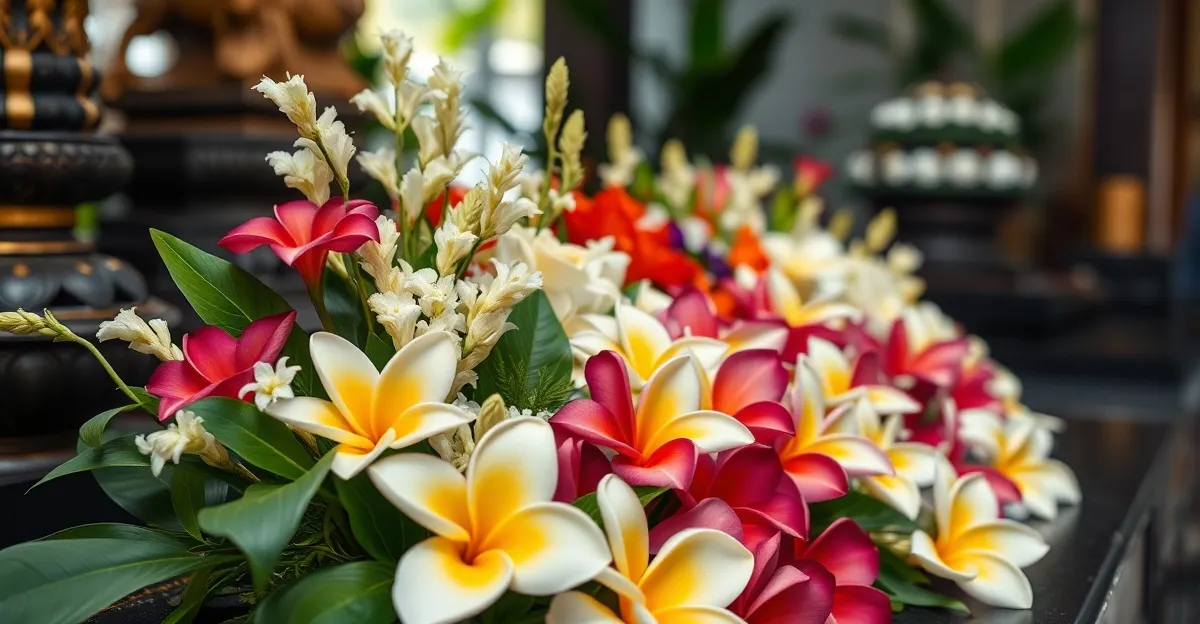
Balinese Hindu funerals — ngaben, the cremation ceremony — are among the most ritually complex and visually extraordinary ceremonies in Balinese life. Unlike many Western funeral traditions that are defined by solemnity and restraint, Balinese funerary rites can be loud, colourful, and community-wide events that last for days. The flowers used throughout the process are integral to the ritual logic, each type and placement carrying specific meaning about the soul's journey and the family's offerings to the departing.
Understanding floral protocol at a Balinese funeral helps both Balinese families navigating ceremony planning and respectful visitors or colleagues who want to show appropriate condolences.
The spiritual framework: the soul's journey
In Balinese Hinduism, death is not an ending but a transition. The soul (atman) departs the body and must be properly prepared for its journey — first to the realm of ancestors, and eventually toward moksa (liberation and union with the divine) or rebirth. The ngaben ceremony is the mechanism for this preparation. Cremation releases the atman from the body so it can continue its journey.
The elaborate offerings, prayers, and flowers throughout ngaben are directed at facilitating this journey — helping the soul depart cleanly, ensuring it is properly welcomed in the ancestral realm, and expressing gratitude for the life that was lived.
Flowers used in the pre-cremation period (sawa)
Between death and cremation, the body (sawa) is prepared and kept in the family compound. The timing of cremation can range from a few days (for those who can afford immediate ceremony) to months or even years (when families save money or wait for an auspicious date). During this period:
White flowers predominate: White is the colour of purity and the soul's transition. White frangipani, white orchids, and white chrysanthemums are placed around the body. White frangipani in particular has specific spiritual significance — its scent is understood to comfort the departing soul.
Marigolds in offering trays: Canang sari offerings are made daily at the head of the body. These include marigolds, frangipani, and incense, placed to nourish and calm the soul during its time in the compound.
Fragrant flowers for ritual baths: The body is bathed ceremonially before preparation. Fragrant flower petals — frangipani, gardenia (sandat), and champak — are added to the water for this ritual.
Flowers in the wadah (tower) and bade (cremation tower)
One of the most visually striking elements of a Balinese cremation is the elaborately decorated tower (bade or wadah) used to carry the body to the cremation ground. These structures — which can be 10 metres tall for high-caste families — are decorated with mirrors, cloth, and flowers.
White and gold decoration: The colour scheme of the bade is typically white and gold, reflecting purity and divine favour. White frangipani garlands are wound through the structure alongside gold and white cloth.
Marigold decorations: On the lower tiers of the bade, marigold decorations appear in profusion — their golden colour associated with prosperity and auspicious transition.
Palm leaf weavings with flower elements: The intricate coconut palm leaf carvings (janur) that decorate the bade often incorporate dried or pressed flower elements alongside the leaf work.
Flowers for the lembu (cremation bull)
For high-caste Balinese families, the body is placed inside a lembu — an ornate, usually black bull sculpture made from wood, bamboo, and cloth — and cremated within it. The lembu is richly decorated with flowers, mirrors, and fabric. White frangipani and marigolds again dominate the floral decoration, with the entire structure becoming a moving floral offering for the soul's departure.
What to send as a condolence gift
If you're a friend, colleague, or business associate of a Balinese family experiencing a death, flowers are an appropriate condolence gesture. However, the guidance for ngaben condolence flowers differs from Western funeral flowers:
Appropriate choices:
- White flower arrangements — white frangipani, white orchids, white chrysanthemums, white lilies
- Mixed white and yellow (marigold tones) arrangements
- Arrangements that incorporate frangipani and other ceremony flowers
Avoid:
- All-red arrangements (red has specific deity and ritual associations that can be contextually inappropriate for funeral settings)
- Extravagant, overly decorative bouquets that feel more celebratory than ceremonial
- Flowers associated in the giver's culture with celebration (multicoloured balloons, bright tropical mixes) that don't carry any ceremony weight
The gesture matters more than the perfect flower choice. A simple arrangement of white flowers with a sincere card is always appropriate.
Timing: Flowers can be sent from the time of death through the cremation period. After the cremation, the family enters a period of purification and rest. Sending flowers immediately upon hearing the news is appropriate and warm.
The ngerorasin ceremony and flowers after cremation
Several days after cremation, a purification ceremony (ngerorasin or ngroras) is held to conclude the ritual cycle for the departing soul. Flower offerings are made at this ceremony as well, typically centred on white and yellow tones.
The ashes are collected and, in a final ceremony, taken to the sea (nyegara gunung) or a river for immersion. This ceremony also involves flower offerings — flowers scattered on the water as a final farewell.
For families in areas close to the sea — Seminyak, Sanur, Jimbaran, Kuta — the final ash-scattering ceremony at the beach involves flower petals scattered on the waves. In highland areas near rivers, the same ritual happens at riverbanks.

The team
your florists
weekly subscription · Bali
We write about flowers because we love them. We deliver them because someone should — properly, weekly, across Bali.
— heyflowerPay once for 3, 6, or 12 months, no auto-renewal.
Caste and ceremony scale
The scale of flowers used in ngaben varies significantly with the deceased's caste (wangsa) and social status. For a Brahmin (high priest caste) or Ksatria (royal caste) family, ngaben can be an enormous public ceremony lasting many days, with thousands of kilograms of flowers used in bade construction and ceremony offerings. For Sudra (commoner caste, by far the largest group in Bali) families, the ceremony is more modest but follows the same basic ritual structure.
What doesn't vary: the spiritual intention behind the flowers. Whether the arrangement is modest or grand, the flower is a vehicle for prayer and respect for the departing soul.
For visitors witnessing a ngaben
If you're in Bali and encounter a ngaben procession — and you will, eventually, if you spend enough time there — you're witnessing something deeply important to the community. The procession may involve hundreds of people carrying the bade through the streets, deliberately spinning it at crossroads to confuse the soul and prevent it from finding its way back to the compound.
Watch with respect. Photography is generally acceptable from a respectful distance, though it's worth asking a nearby Balinese person if it's okay. Don't cross in front of the procession or interfere with the path.
The flowers you see — the frangipani garlands, the marigold decorations, the white arrangements on the bade — are all working parts of a ceremony helping someone's loved one make a sacred journey.
FAQ
Is it appropriate for non-Balinese people to attend an ngaben? Ngaben ceremonies are community events, and respectful visitors are generally welcomed. Wear white or muted colours (not bright or festive), follow the lead of locals around you, and be unobtrusive.
What colour clothes should I wear to a Balinese funeral? White is traditional for Balinese mourners. Non-Balinese visitors wearing muted colours — cream, beige, soft grey, pale yellow — show appropriate respect. Avoid bright colours and patterns.
Can I bring flowers to the family home after a death in their family? Yes. White flower arrangements are appropriate and welcomed. Arrive quietly, express condolences sincerely, and don't stay long unless invited.
Why are chrysanthemums appropriate in Balinese funeral contexts? Chrysanthemums are associated with ceremony and spiritual matters in various Asian traditions. In Bali, white chrysanthemums carry no negative associations and appear in ceremony offerings. They're an appropriate choice for condolence flowers.
How long does the ngaben process usually take? The timing varies widely. For wealthy families, cremation can happen within a week of death. For other families, the body may be kept for months or years while the family saves for the ceremony or waits for an auspicious date. The ceremony itself typically lasts one to three days.
Ready to bring fresh flowers to your Bali home or event? Explore our weekly flower subscription and get handpicked blooms delivered to your door every week.



