Flowers in Balinese dance: headpieces and costumes
Flowers are structural elements of Balinese dance costumes — not decoration added after the fact. Here's which dances use fresh flowers, how headpieces are made, and what the flowers mean.
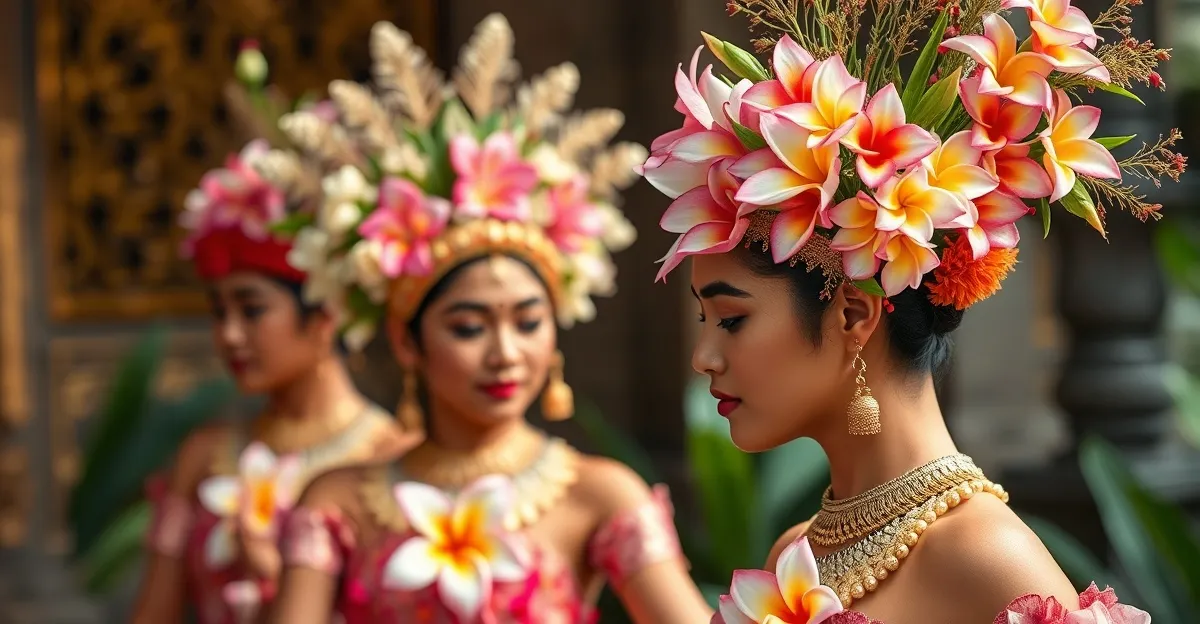
Balinese dance is one of the most visually dense performing art forms in the world. Every element of the costume carries meaning: the gilded fabric, the specific colours, the hand ornaments, the elaborate headpiece. And running through it all, interwoven with gold leaf and lacquered wood, are flowers. Real flowers. Fresh-cut, fragrant, and precisely placed.
Understanding the role of flowers in Balinese dance moves you from seeing a performance as a spectacle to understanding it as a ceremony — which, in most traditional contexts, is exactly what it is.
Why Balinese dance uses fresh flowers
In Balinese Hindu cosmology, performing arts are not separate from religious practice. The major dance forms — Legong, Baris, Topeng, Barong, Gambuh — are offered to the divine. They take place in temple courtyards, at ceremony, and at specific points in the ritual calendar. The performers are understood to channel divine energy through their movements, and their costumes are the garments of that channelling.
Fresh flowers carry living spiritual energy in Balinese understanding. A dancer wearing real frangipani in her headdress is not wearing a more expensive version of plastic flowers — she's wearing something that participates actively in the spiritual dimension of the performance. The fragrance lifts toward the divine; the living flower witnesses and participates.
This is why, even for short performances, even in the heat, experienced Balinese dance costume makers use real flowers wherever tradition calls for them.
Legong: the pinnacle of floral costuming
Legong is arguably the most refined and demanding of Balinese female dance forms. Performed traditionally by pre-pubescent girls in elaborate full costume, Legong requires months of intensive training. The costuming process alone — applying gilded fabric, gold ornaments, and the headdress — takes one to two hours before the performance begins.
The Legong headdress (gelung) is a masterwork of flowers and goldwork:
Fresh frangipani: White frangipani blooms are tucked into the gilded structure of the headdress at specific positions. The flowers frame the dancer's face and crown her head. They're secured with small wires and fresh stems, placed by experienced hands on the day of performance.
Fragrant champak (kemoning): The white champak flower, valued for its intense fragrance, appears in Legong headdresses for its scent-carrying properties — the fragrance ascends during the performance.
Marigold accents: In some regional Legong styles, particularly from the Tabanan area, small marigold elements appear in the headpiece construction.
Golden frangipanis: Not all "flowers" in the headpiece are fresh — many Legong headdresses incorporate gilded paper or fabric flower shapes (replica jepun) alongside real ones. The mix of real and replica is standard practice.
The effect is extraordinary: under strong lights or in direct sunlight, the fresh flowers gleam alongside the gold, and the fragrance moves with the dancer.
Barong: the protective spirit's floral mask
The Barong is the lion-like protective spirit of Balinese mythology — a cosmic protector who battles against Rangda (the demon queen) in the most commonly staged Balinese dance drama. The Barong costume is worn by two dancers (front and back) under an elaborately decorated mask and body.
The Barong's decoration is dense with sacred materials. Flowers appear in the decorative panels that hang from the Barong's sides and in the ritual garlands placed on the costume before performance. Marigolds, frangipani, and sometimes hibiscus are woven into garlands that both decorate and ritually protect the costume.
Before a Barong performance, particularly one that's part of actual ceremony (rather than a tourist performance, though the distinction is sometimes blurred), the costume is blessed with holy water (tirta) and freshly placed flowers by a priest or ritual specialist. This is not optional — it's what makes the costume an active spiritual object rather than a theatrical prop.
Baris: warrior dance and its floral crown
Baris is a sacred male warrior dance performed in ceremony contexts at temple anniversaries. The dancer embodies a divine warrior, and the costume reflects that — elaborate fabric, ornamental weapons, and a tall headdress that sways and catches light.
The Baris headdress (gelungan baris) is tall and triangular, covered in shell decorations and small floral elements. Fresh flowers are incorporated — white frangipani and champak particularly — in the ritual dressing before the performance. The dressing of a Baris dancer in full ceremony context is itself a ritual act, not just costume application.
Topeng: mask dance and minimal flowers
Topeng is the Balinese mask dance form, where a solo dancer or small company performs stories from the Babad (Balinese chronicles) using a series of different masks. Because the face is covered, the headdress and surrounding costume are even more important as visual elements.
Topeng uses relatively few fresh flowers compared to Legong — the masked characters are more about earthly human drama than divine feminine refinement. However, the ritual masks themselves may be dressed with fresh flowers before ceremony-context performances, and the more divine characters (in Topeng Keras, the refined refined characters) in the extended Topeng Pajegan (full solo Topeng) may have flower elements in their headdresses.
The making of a dance headdress: before performance
The application of flowers to a Balinese dance headdress is done close to performance time — ideally within the hour before the dancer goes out. This is because the flowers need to be fresh and the headdress stable.
The process:
-
The base structure of the headdress — gilded papier-mâché, lacquered wood, or pressed materials — is secured to the dancer's head with pins and sometimes a base plate that anchors to the hair.
-
Ornamental elements (gilded flowers, mirror pieces, painted designs) are already attached to the base structure.
-
Fresh flowers are then placed into prepared positions in the structure — either into small wire loops that hold stem ends, or tucked into gaps in the structure.
-
A final dressing check ensures the flowers are secure, the headdress is stable, and the overall silhouette is correct.
The person doing this work is often a specialist — either an experienced senior dancer or a dedicated costume maker (penata rias) who has worked with the dance group for years. Making these headdresses well is a genuine skill.

The team
your florists
weekly subscription · Bali
We write about flowers because we love them. We deliver them because someone should — properly, weekly, across Bali.
— heyflowerPay once for 3, 6, or 12 months, no auto-renewal.
Tourist performances vs. ceremony performances
Bali has a thriving tourist-oriented performance circuit — nightly Kecak performances at Pura Uluwatu, Legong shows at various cultural centres, Barong performances in Batubulan. These performances use real traditional costumes, including fresh flowers in the headdresses, but they're not in a temple ceremony context.
Ceremony performances — Baris danced at an odalan, Topeng performed at a rite of passage, Sanghyang Dedari (trance dance) performed in specific ritual contexts — are categorically different. The spiritual stakes are higher, the flower use more deliberate, and the entire dressing process more ritually significant.
Both are worth seeing, but understanding the difference helps you appreciate what you're watching.
For a parallel look at flowers in bridal contexts (which have some overlap with ceremonial costuming), flower headdresses at Bali weddings: symbolism and making covers similar territory.
Flowers in Kecak: the group dimension
Kecak — the famous choral performance derived from the sanghyang trance ritual — uses minimal individual costuming but significant collective flower use. The male chorus (kecak voices) wears checked sarongs and floral headdresses — a simple ring of fresh flowers around the head.
For major ceremony-context Kecak performances, the floral rings are made fresh on the day. For tourist performances, they may be dried or fabric representations. The smell of fresh flowers on a hundred men gathered in a torchlit ring is something you don't forget.
FAQ
Are the flowers in Balinese dance headdresses always real? In ceremony-context performances, yes — real flowers are considered important. In some tourist-context performances, a mix of real and artificial may be used for practicality. Top-quality performance companies always use real flowers.
How do dancers keep flowers fresh during a long performance? The flowers are placed just before performance and the performance itself is usually not long (30 minutes to 1.5 hours for tourist shows; ceremony performances vary). The dancer's body heat and movement can stress flowers, which is why hardy fragrant blooms (frangipani, champak) are chosen over delicate ones.
Can visitors buy Balinese dance headdresses as souvenirs? Replica headdresses made with fabric and artificial flowers are sold throughout Bali as art objects and souvenirs. Actual ceremony-quality headdresses made by skilled craftspeople are not typically for sale, as they're associated with specific dance groups and sacred contexts.
Why do Balinese dances use specific flower types and not others? Tradition, fragrance, and spiritual association. Frangipani and champak are chosen for their fragrance-carrying properties. Marigold is universally ceremony-appropriate. These choices have been consistent for centuries and are considered part of the dance tradition, not merely aesthetic.
Is Legong considered the most elaborate flower costuming in Balinese dance? Yes, generally. The Legong headdress in full traditional form represents the apex of Balinese dance floral costuming in terms of complexity, refinement, and the integration of fresh flowers with gilded materials.
Ready to bring fresh flowers to your Bali home or event? Explore our weekly flower subscription and get handpicked blooms delivered to your door every week.



