Colors in Balinese offerings: red, white, yellow, black, blue
Discover the sacred meaning behind each colour in Balinese Hindu offerings — the five-direction system linking red, white, yellow, black, and blue to specific deities.
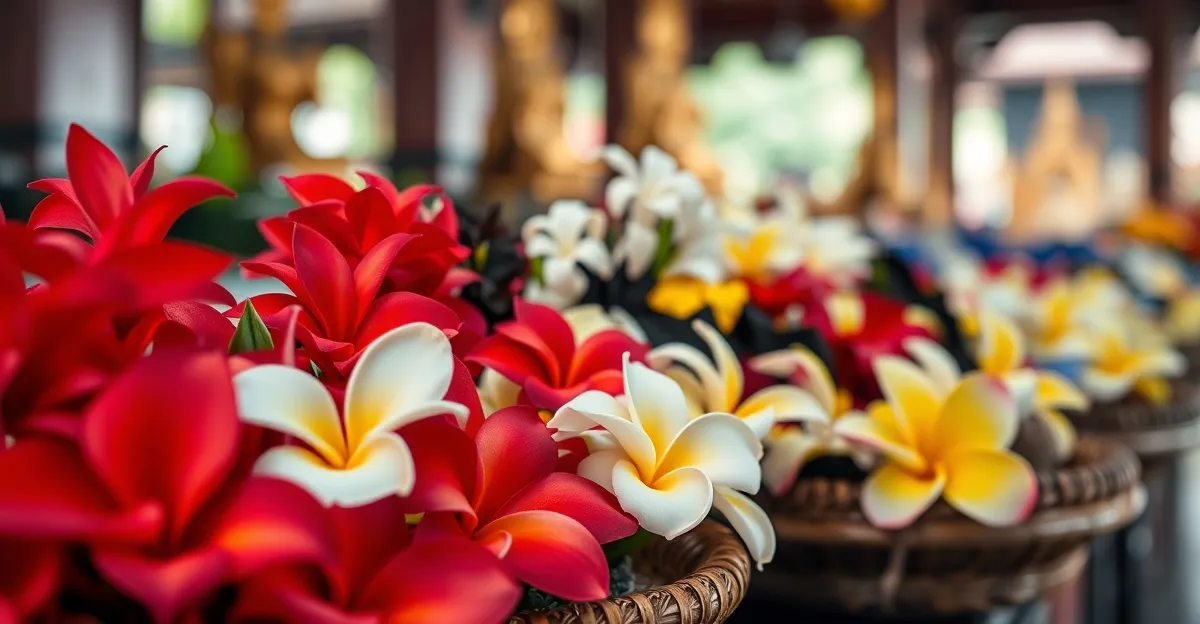
Stand at the edge of any Balinese flower market early on a ceremony morning and you'll notice the sellers have organized their stock not by flower type but by colour. Yellows here, whites there, reds and pinks across the aisle. This isn't just visual merchandising — it reflects a deep structural logic that runs through Balinese Hinduism: the system of Panca Dewata, the five deities of the five directions, each with their own colour, element, flower, and sacred significance.
Understanding the colour system of Balinese offerings is one of the most direct ways to read the island's ritual language. Once you know it, you start seeing it everywhere — in the colour of temple decorations, in the arrangement of flowers on a shrine, in the sequence of offerings laid out for a major ceremony. It's a living code, expressed fresh each morning in millions of small trays across Bali.
The Panca Dewata: five directions, five deities, five colours
The foundation of the Balinese offering colour system is Panca Dewata — the five deities who govern the four cardinal directions plus the centre. This framework derives from Tantric Hinduism and was transmitted to Bali through the Javanese Majapahit influence, then developed into distinctively Balinese form over centuries of local practice.
The five pairings are:
- East → Iswara → White
- South → Brahma → Red
- West → Mahadeva → Yellow
- North → Wisnu → Black (sometimes represented by blue)
- Centre → Siwa → Mixed / All colours
This is not an arbitrary aesthetic system — it encodes a cosmology. Each deity governs not only a direction but an element, a time of day, a quality of consciousness, and a stage of the ritual calendar. The colours are therefore not decorations but identifiers. When you place a white flower on the eastern side of a canang, you are addressing Iswara. When you place red hibiscus on the southern side, you are directing the offering toward Brahma's fire.
White: the east, Iswara, and purity
White is associated with Iswara and the east — the direction of sunrise, of beginnings, of purification. In Balinese Hindu thought, white represents suci (sacred purity) and clarity of mind. It is the colour of the divine in its most pristine, unmediated form.
The most common white offering flowers are white frangipani (jepun putih), white plumeria more broadly, and white jasmine when available. White petals scattered across the centre of a canang are a gesture of inviting divine presence at its purest.
The complication, as explored in why some Bali families avoid white flowers outside of funerals, is that white also dominates the colour scheme of ngaben (cremation) ceremonies. This dual use — purity in daily offerings, mourning in funerary contexts — makes white the most contextually sensitive colour in Bali's flower vocabulary.
In the offering system, white's position is unambiguously sacred. In gifting, it requires awareness of the recipient and occasion.
Red: the south, Brahma, and creative fire
Red is Brahma's colour, linked to the south and to the element of fire. Brahma is the creator deity in the Hindu Trimurti — the one who initiates, energises, and brings things into being. Red in offerings therefore carries the energy of creation, vitality, and transformative power.
The primary red offering flower is hibiscus (pucuk), specifically the red single-flower species that grows in most Balinese compound gardens. It's picked fresh each morning — hibiscus doesn't last long after cutting — and placed on the southern side of the canang tray. Red rose petals are also used, as is red canna lily.
Beyond the offering tray, red appears prominently in the cloths wrapped around shrines and in the decorations of sacred buildings associated with Brahma's fire energy. At the fire altar (pagentur) during major ceremonies, red fabric and red flower arrangements dominate.
In the broader Bali gift-giving context, red flowers are read as auspicious and energising — appropriate for celebrating achievement, new beginnings, and major life events. Red isn't shy in Bali's flower culture.
Yellow: the west, Mahadewa, and sustaining life
Yellow belongs to Mahadewa and the west — the direction of sunset, of water, of the nourishing qualities that sustain life. Yellow in Balinese offerings is associated with prosperity, abundance, and the divine's role in maintaining the world.
Yellow champaca (cempaka kuning) is the ideal yellow offering flower, highly valued for its intense fragrance and small, precise blooms. Yellow marigold (tagetes) is the most common substitute — practical, available year-round, and exactly the right colour. Yellow chrysanthemum is also used in some traditions.
Yellow flowers are probably the most consistently positive in Bali's colour vocabulary. Unlike white (which has funerary associations) or red (which is powerful but potentially assertive), yellow is reliably read as welcoming, warm, and prosperity-invoking. This is partly why yellow plays such a large role in festival decorations during Galungan and Kuningan — the penjor bamboo poles are decorated with yellow marigold, and yellow flowers dominate the major shrine decorations during these celebrations.
Black: the north, Wisnu, and protection
Black is Wisnu's colour and governs the north. Wisnu is the preserver deity — the one who maintains cosmic order, protects against chaos, and ensures the continuity of dharma. Black in this system is not morbid but protective: the darkness that holds and contains, the soil from which life grows.
The challenge for offering makers is that truly black flowers are exceptionally rare in nature. This creates one of the more interesting adaptations in the Balinese offering system: black is often represented by very dark blue, deep purple, or even dark green when no other option is available. In some family traditions, black is represented by a small piece of dark fabric or a black seed rather than a flower.
When truly dark flowers are used, they tend to be sourced from import stock — deep purple irises, near-black calla lilies, dark plum anemones — which are expensive and not always available at village-level markets. This is why the north-side placement in many daily canang is the most improvised: offering makers use what dark-coloured element is most accessible.

The team
your florists
weekly subscription · Bali
We write about flowers because we love them. We deliver them because someone should — properly, weekly, across Bali.
— heyflowerPay once for 3, 6, or 12 months, no auto-renewal.
Blue: Wisnu's alternate colour and its practical use
Blue occupies an interesting position in the system. In some Balinese traditions, Wisnu's colour is described as black; in others, it is black-and-blue, or sometimes specifically siyung (dark, uncertain colour). In practice, dark blue flowers — when available — are widely accepted as fulfilling the northern-direction requirement.
Blue hydrangea, when in season, is the most commonly used genuinely blue flower in Bali's offering tradition. Blue agapanthus appears occasionally. Blue morning glory (Ipomoea) grows wild across the island and is sometimes used in everyday offerings when more expensive options aren't available.
The blue/black ambiguity in the system is not a flaw but a feature — it reflects the tolerance for practical adaptation within a living ritual tradition. What matters is the direction, the intention, and the general movement toward Wisnu's dark, protective, preserving energy. The specific shade is less important than the orientation.
Centre and Siwa: the mixed, the total, the transcendent
The centre of the offering tray is associated with Siwa (Shiva) — not just the deity of destruction in the Trimurti, but in Balinese Hinduism specifically Siwa Agung, the supreme deity who contains and transcends all others. The centre is therefore the totality: all colours together, which in practice means mixed flowers, often accompanied by the most fragrant blooms available.
Champaca and frangipani are common centre flowers because of their fragrance. In elaborate offerings, the centre pile might include petals from all four directional colours combined. In simpler canang, a handful of mixed small blooms does the work.
The centre represents the idea that all directions, all deities, all qualities ultimately converge in the one: Siwa as the unified field of divine consciousness. Placing mixed, fragrant flowers at the centre is a gesture toward that unity.
Frequently asked questions
Does every Balinese family use the same colour assignments? The basic Panca Dewata system is consistent across the island, but regional and family variations exist. Some families use slightly different flower species for specific directions based on ancestral instruction. The colours themselves (east=white, south=red, west=yellow, north=dark) are consistent.
Can I use the colour system when making my own canang? Yes. Learning the directional colour system and applying it when you make offerings shows respect and understanding. The preparation itself is considered part of the offering — approaching it with awareness of the system is considered more devotionally complete than placing flowers randomly.
Are these the same colour associations as in other Hindu traditions? There are connections to broader Tantric colour systems, but Bali's specific Panca Dewata assignments are a local development and differ from, for example, the colour associations in Balinese-Hinduism as practiced in Java or in India. Don't assume direct equivalence.
Why do some offerings at temples look different from canang sari in terms of colour arrangement? Larger ceremonial offerings are more complex and may involve multiple banten types with different colour logics for each. Canang sari uses the basic four-direction layout; larger offerings may include additional layers representing different cosmological levels.
What colour flowers should I give someone as a congratulations gift? Yellow, orange, pink, and red are all safe celebratory colours in Bali. A warm-toned mixed bouquet with yellows and pinks reads as wholeheartedly positive in Balinese cultural terms.
Ready to bring fresh flowers to your Bali home or event? Explore our weekly flower subscription and get handpicked blooms delivered to your door every week.



