Dried flower bouquets that last two years
Learn which tropical flowers dry best and how to build a Bali-made dried bouquet that genuinely holds its shape and color for two years or more.
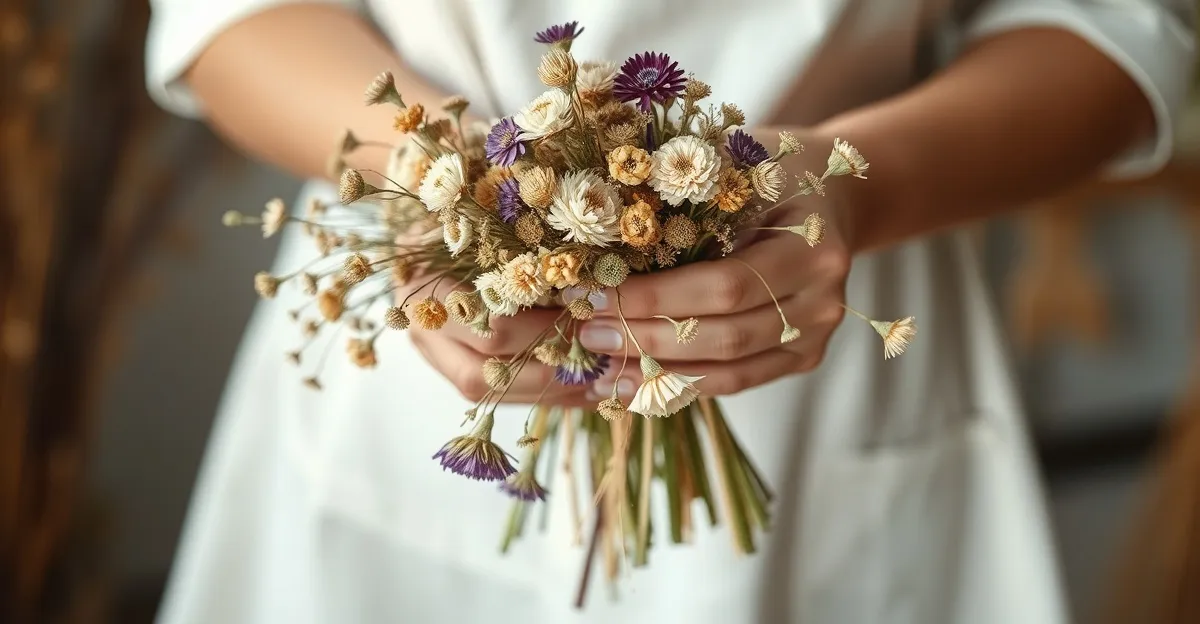
Two years is a real benchmark. It's the point at which a dried flower arrangement stops being a "temporary keepsake" and becomes something that genuinely earns shelf space in your home. It's also the point where many poorly-made dried bouquets have already crumbled, faded to beige, or grown so dusty they've lost all appeal.
Getting to two years — and beyond — with a tropical dried flower bouquet isn't complicated, but it does require choosing the right flowers, drying them correctly, and storing or displaying the finished arrangement with some thought for Bali's humidity. Here's what actually works.
The flowers that reliably make it to two years
Not all dried flowers are created equal. Some simply don't have the cell structure to maintain their form over the long term. In a tropical context, the flowers that make it to two-plus years share a few qualities: naturally lower water content, robust petals or bracts that don't collapse when dry, and pigments that resist UV fading.
Strawflowers (helichrysum) are the undisputed champions of dried flower longevity. Their papery petals are essentially pre-dried by nature — the fresh flower already looks semi-dry. Colors hold extremely well, ranging from deep crimson to pale straw yellow, and a properly dried strawflower will look nearly identical at two years as it did at two months.
Statice (limonium) is the structural backbone of many long-lasting dried arrangements. The small, papery flowers come in lavender, white, yellow, and pink, and they hold their color and shape for years. They also provide excellent filler texture around larger, more dramatic blooms.
Banksia and other proteaceae hold magnificently. The cone-like forms and unusual textures of banksia, leucadendron, and protea give a bouquet visual weight that doesn't depend on color alone — the structural interest remains even as the coloring shifts slightly over time.
Dried palm inflorescences and coconut palm flowers — locally available in Bali from palm growers in Tabanan and Negara — add dramatic texture and are virtually indestructible once dry.
Bunny tail grass (lagurus) and other ornamental grasses hold their fluffy texture long-term and provide movement and softness without the fragility of flower petals.
For Bali-specific tropical options, heliconia bracts can last two years when dried properly, though the vivid red and orange tend to deepen toward terracotta over time. Bird of paradise similarly holds its distinctive form but the blue typically shifts toward grey over a year or two. These are worth including for their structural impact even if the color transformation is expected.
Drying techniques that actually work in tropical humidity
The enemy of long-lasting dried flowers in Bali is moisture, and every step of the drying process should be about removing moisture as thoroughly as possible before the flower ever goes into a display.
Air-drying: The simplest method, suitable for most of the flowers listed above. Tie stems in small bunches (five to ten stems, loosely enough to allow airflow) and hang upside down in the driest, most ventilated space you have. An air-conditioned room is ideal. Allow two to four weeks. Test by snapping a stem — it should break cleanly, not bend.
The common mistake in Bali is rushing this step. Flowers that seem dry on the surface can still hold moisture in the stem base or flower center. An extra week of drying makes a meaningful difference in longevity.
Silica gel drying: Faster (four to ten days) and preserves color and three-dimensional form better than hanging. Particularly worth using for roses, ranunculus, and any flower you want to keep looking close to fresh. Cover the blooms completely in silica gel crystals in an airtight container. Check at four days and every day thereafter — over-drying causes brittleness.
Microwave drying with silica gel: Very fast (one to three minutes on low power) but requires care. Best for single blooms rather than full bunches. The results can be excellent but there's a learning curve — different flowers need different timing.
Building the bouquet for longevity
Structure matters in a dried bouquet. The arrangement should be built in a way that minimizes mechanical stress on the dried stems and blooms — dried flowers are inherently brittle, and an arrangement that shifts frequently or isn't supported properly will shed and break long before two years.
Wire and floral tape are your friends here. Reinforce fragile stems with thin floral wire before the flowers are fully dry — it's much easier to insert wire through a semi-pliable stem than a fully brittle one. Wrap the wire with brown or green floral tape so it disappears visually.
Use a sturdy base — a ceramic vase, a terracotta pot, or a wicker basket filled with dry floral foam (not water-absorbing foam, which introduces moisture). Pack the foam firmly so stems don't shift.
Build the arrangement starting with structural elements (banksia cones, dried grasses, statice branches) before adding the feature flowers. This way, the feature blooms have support on all sides.
Once the arrangement is complete, a very light spray of unscented hairspray or specialty floral sealant can help hold petals in place without significantly affecting the visual appearance. Apply from at least 30cm away in a sweeping motion.
Display and care in Bali's climate
Where you place the arrangement makes a significant difference in how long it lasts.
Avoid direct sunlight: UV fading is the main color killer. Even an east-facing window that only gets morning sun will accelerate fading over two years. Display dried arrangements in areas with bright indirect light rather than direct rays.
Avoid high-humidity areas: Bathrooms, areas near kitchens, and naturally ventilated rooms during the wet season are all challenging. An air-conditioned living room in Seminyak or Canggu is close to ideal — stable temperature and lower humidity.
Dust carefully: Dust is inevitable and builds up on dried flowers over time. Use a very soft paintbrush or a can of compressed air (available from photography supply shops in Denpasar) to clean the arrangement every few months. Never use a damp cloth.
Keep away from fans and AC vents: Constant airflow directed at dried flowers causes petal loss and stem fatigue. Place arrangements where they won't be in the direct path of air movement.
For anyone using flowers from a weekly subscription, how to turn a subscription bouquet into a dried wreath covers another approach to long-term display, and the shoulder season (Apr, Oct): flowers that thrive is useful for understanding which Bali blooms arrive in best condition for drying.

The team
your florists
weekly subscription · Bali
We write about flowers because we love them. We deliver them because someone should — properly, weekly, across Bali.
— heyflowerPay once for 3, 6, or 12 months, no auto-renewal.
What to expect as the arrangement ages
A good dried arrangement doesn't stay static — it evolves. The first six months is the display period where the arrangement looks closest to its original state. From six months to a year, subtle color shifts happen: reds deepen, yellows warm toward ochre, whites move toward cream. From one year to two, the palette becomes more unified and muted. This isn't failure — it's patina, and many people find aged dried arrangements more beautiful than fresh ones for this reason.
The goal at two years isn't "still looks like it just arrived." It's "still looks intentional and beautiful." Banksia cones, statice, and strawflowers will genuinely reach two years looking deliberate and lovely. More delicate inclusions like dried rose petals or grass will vary.
FAQ
Can I make a two-year dried bouquet from a fresh weekly delivery? Yes, with selection. Choose the sturdier flowers from each delivery — roses, strawflowers if included, ornamental grasses — and dry them progressively, adding to a growing dried arrangement over time. More delicate flowers like freesia are better pressed than dried standing.
Do dried flowers attract insects in Bali? Less than fresh flowers, but not zero. Silverfish and certain beetles can be attracted to dried plant material. Placing a small sachet of dried cloves or cedar chips near (not in) the arrangement discourages insects. Check arrangements periodically, especially during the wet season.
What's a realistic budget for a quality dried bouquet in Bali? A properly made dried bouquet using premium imported dried elements (banksia, protea, pampas grass) alongside local tropical flowers typically ranges from Rp 250,000 to Rp 700,000. Arrangements made primarily from locally dried blooms can be done for significantly less.
Should I use a vase or hang a dried bouquet? Both work. Hanging keeps the stems straight and allows 360-degree viewing, which can be beautiful against a whitewashed wall. Vase display makes it easier to rearrange. For two-year longevity, upright in a dry vase tends to be more stable than hanging in Bali's humidity.
Can I ship a dried bouquet overseas from Bali? Dried flowers generally clear customs more easily than fresh ones, but packaging needs to be secure against crushing and completely dry to satisfy phytosanitary rules. Most dried flowers can be sent to Singapore and Australia with proper documentation; check current rules for your destination country.
A two-year dried flower bouquet is a completely achievable goal with the right flower selection and proper technique. In Bali, where fresh tropical blooms are readily available and the drying conditions can be managed with a bit of care, there's no reason a well-made arrangement shouldn't be gracing your shelf years from now.
Ready to bring fresh flowers to your Bali home or event? Explore our weekly flower subscription and get handpicked blooms delivered to your door every week.



